
As an Amazon Associate I earn from qualifying purchases. This may be at no additional cost to you.
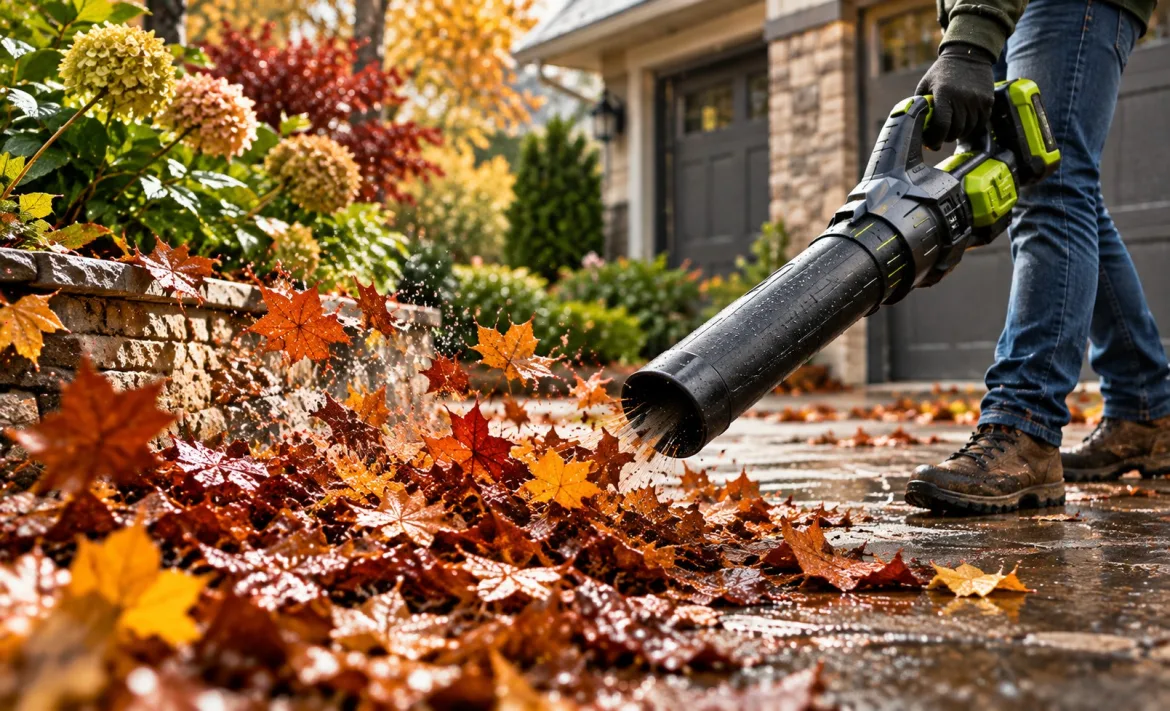
Dry leaves are easy. Wet leaves are where a cordless blower shows what it can really do.
If you’ve ever tried to move rain-soaked maple leaves stuck to the lawn, a heavy pile collected along a fence, or damp debris packed into the corner of a driveway, you already know that a lightweight blower that seems perfectly fine in summer can suddenly feel useless in October.
The good news is that today’s stronger cordless leaf blowers are no longer just for clearing a deck or blowing grass clippings off the driveway. The right machine can handle serious fall cleanup — but you need to look beyond the battery voltage printed on the box.
Quick Picks: Cordless Leaf Blowers for Real Fall Cleanup
Best for Most Yards: EGO POWER+ 765 CFM
765 CFM · 200 MPH · 56V
A strong all-around choice for the typical suburban yard, especially when you need enough power for both dry and wet leaves without stepping up to professional equipment.
Best for Wet, Packed Leaves: Husqvarna 350iB Leaf Blaster
800 CFM · 200 MPH · 23.5 N
If your fall cleanup involves mature trees, wet leaves and heavy piles rather than a handful of dry leaves on the patio, this is the kind of power worth looking at.
Best for RYOBI Owners: RYOBI 40V HP Whisper Series
730 CFM · 190 MPH · 40V
A particularly sensible choice if you already have RYOBI 40V yard tools and batteries sitting in the garage.
Best Value High-Power Option: Greenworks 80V 730 CFM
730 CFM · 170 MPH · 80V
A useful middle ground for homeowners who want serious airflow but don’t necessarily want to move into the most expensive professional-style battery systems.
Can a Cordless Leaf Blower Really Move Wet Leaves?
Yes — but not every cordless blower can do it well.
A small blower can look impressive when it’s pushing dry leaves across concrete. Wet leaves are different. They stick to grass, flatten against pavement and form dense piles that require both a large volume of air and enough air speed to break them loose.
For a typical suburban property, that means you don’t necessarily need the biggest blower sold at the hardware store. But if your yard sits under mature maples, oaks or other large deciduous trees, buying too little power usually means spending far more time on fall cleanup.
Simple rule: if you’re regularly moving wet leaves from grass rather than dry leaves from a driveway, shop for real blowing performance — not just the cheapest cordless tool with a battery attached.
CFM vs. MPH: The Two Numbers That Actually Matter
Leaf-blower marketing can make this unnecessarily confusing, so here’s the homeowner version.
CFM — cubic feet per minute — tells you how much air the blower moves. High CFM helps push large piles and move a wider mass of leaves.
MPH tells you how fast that air is moving. Higher air speed helps break stubborn leaves and debris loose from grass, pavement and corners.
For wet leaves, you want a useful combination of both.
A blower with a very narrow, fast air stream may loosen stubborn debris but take forever to move a large pile. A high-CFM machine with weak air speed may move plenty of dry material but struggle with leaves plastered to wet grass.
That’s why models in the roughly 700–800 CFM and 170–200 MPH range are so interesting for serious homeowner fall cleanup.
Which Leaf Blower Fits Your Yard?
You don’t need the same machine for a quarter-acre suburban lot as you do for an acre surrounded by mature trees.
Small yard, driveway and deck
You probably don’t need maximum power. Prioritize manageable weight, easy speed control and a battery that works with other tools you already own.
Typical suburban yard
This is where the EGO 765 makes a lot of sense. It has enough reserve power for wet leaves without feeling like you’re buying commercial equipment for a 20-minute cleanup.
Mature trees and heavy fall leaf drop
The Husqvarna 350iB becomes much more interesting when you’re repeatedly dealing with large piles, wet grass and leaves packed along fences or landscaping.
Already own a battery platform
Don’t ignore the batteries in your garage. If you already own several RYOBI 40V or Greenworks 80V tools, staying in the same battery ecosystem can make more sense than buying a technically better blower plus an entirely new battery and charger system.
Four Cordless Leaf Blowers Worth Comparing
| Model | Max Airflow | Max Air Speed | Best For | Shop |
|---|---|---|---|---|
| EGO POWER+ LB7654 | 765 CFM | 200 MPH | Most suburban yards | Check price |
| Husqvarna 350iB | 800 CFM | 200 MPH | Wet, heavy leaves | Check price |
| RYOBI RY404100 | 730 CFM | 190 MPH | RYOBI 40V owners | Check price |
| Greenworks 80V | 730 CFM | 170 MPH | High-power value | Check price |
EGO POWER+ 765 CFM — Best Fit for Most Suburban Yards
The EGO LB7654 is probably the easiest model here to recommend to the homeowner who wants serious power without turning yard cleanup into a professional landscaping project.
It reaches up to 765 CFM and 200 MPH in Turbo mode. EGO specifically lists wet leaves, mud and other heavy debris among the jobs the blower is designed to handle.
That’s important because most of us don’t need maximum output every second we’re outside. You may use moderate power while sweeping leaves across an open lawn, then hit Turbo when you reach wet leaves stuck against the curb, under shrubs or beside the driveway.
What stands out: strong balance between airflow and speed, variable control and a mature 56V battery platform.
What to know: using Turbo continuously will drain a battery much faster than normal blowing. Manufacturer runtime figures should never be interpreted as “this will run at maximum power for that entire time.”
Best for: homeowners with a normal suburban lawn who want one capable blower for grass clippings, driveway cleanup and serious fall leaves.
Check the EGO POWER+ 765 CFM on Amazon →
Husqvarna 350iB Leaf Blaster — Best for Wet, Heavy Leaf Piles
If you have several large trees on the property, the difference between “clearing a few leaves” and “fall cleanup” becomes obvious very quickly.
The Husqvarna 350iB delivers up to 800 CFM, 200 MPH and 23.5 Newtons of blowing force. Husqvarna also gives it a Boost mode for stubborn debris.
This is the model I’d look at when wet leaves are the actual problem rather than an occasional inconvenience.
Think soaked leaves stuck to the back lawn, a thick pile pushed against a fence after a storm, or leaves mixed with small twigs and yard debris. That’s where extra blowing force starts to matter.
What stands out: very strong airflow and air speed in a handheld format.
What to know: check carefully whether the Amazon listing you’re opening is the tool-only version or a kit with battery and charger. The price difference can be substantial.
Best for: properties with mature deciduous trees and homeowners who regularly tackle heavy fall cleanup.
Check the Husqvarna 350iB on Amazon →
RYOBI 40V HP Whisper Series — Best if You Already Own RYOBI
Battery compatibility is one of the most overlooked parts of buying cordless yard equipment.
RYOBI’s RY404100 produces up to 730 CFM and 190 MPH. The kit sold in the U.S. through Home Depot includes two 40V 4Ah batteries, and RYOBI’s 40V platform covers a large range of outdoor tools.
If there are already RYOBI batteries on the garage shelf for your mower, trimmer or hedge trimmer, that matters.
A blower doesn’t live in isolation. Once you start buying cordless yard equipment, batteries often cost enough that the ecosystem becomes part of the buying decision.
What stands out: plenty of power for homeowner use, plus the practical advantage of the established RYOBI 40V system.
What to know: this particular RYOBI line is closely associated with Home Depot in the U.S., so Amazon availability can vary by seller. Always check who’s selling the item and exactly what the package includes.
Best for: homeowners who already use RYOBI 40V outdoor tools.
Check current RYOBI options on Amazon →
Greenworks 80V 730 CFM — Best Value High-Power Alternative
Greenworks has become a familiar name in battery-powered outdoor equipment, and its 80V platform gives homeowners another route into higher-powered cordless yard tools.
This 80V blower reaches up to 730 CFM and 170 MPH. Greenworks specifically markets the model for dry and wet leaves, grass and stubborn debris.
Its maximum air speed isn’t as high as the EGO or Husqvarna models above, but 730 CFM gives it substantial airflow for moving piles across an open yard.
What stands out: high airflow and access to the broader Greenworks 80V tool platform.
What to know: Greenworks sells several blower configurations, and Amazon listings may mix tool-only versions, kits and different voltage platforms. Make sure you’re looking at the 80V 730 CFM version if that’s the model you want.
Best for: homeowners who want strong cordless performance while comparing the cost of the entire battery system, not just the blower itself.
Check Greenworks 80V options on Amazon →
Don’t Buy the Blower Without Looking at the Battery
This is where cordless tools can get expensive.
A bare tool can look like a bargain until you realize that you still need a high-capacity battery and charger. On the other hand, paying for another kit may be unnecessary if you already have compatible batteries.
Before ordering, check four things:
- Is it tool-only or a complete kit?
- What battery capacity is included?
- Can that battery run other yard tools you plan to buy?
- How much does a second battery cost?
If you’re building a cordless yard-tool collection from scratch, choosing the battery platform can be almost as important as choosing the blower.
How Much Runtime Do You Really Need?
Runtime numbers are easy to misunderstand because manufacturers typically quote them under specific operating conditions.
That’s not how most homeowners use a blower in October.
Real cleanup usually looks more like this: moderate power across the lawn, lower power around flower beds and mulch, then short bursts of full power on wet piles, driveway corners and leaves caught against the fence.
For a smaller suburban lot, you may not need an hour of continuous full-power blowing. A focused 15–30 minute cleanup can be enough.
For a larger property with mature trees, however, a second battery can be far more valuable than another 50 CFM of advertised airflow.
FAQ: Cordless Leaf Blowers for Wet Leaves
How much CFM do I need for wet leaves?
There isn’t one magic number, because nozzle design, air speed and blowing force also matter. For genuinely heavy fall cleanup, models around 700 CFM and above give you considerably more airflow than lightweight cleanup blowers.
Is MPH or CFM more important?
You need both. CFM moves the pile; MPH helps loosen stubborn material. For wet leaves stuck to grass, a strong combination is more useful than chasing the highest number in only one column.
Can a battery leaf blower replace a gas blower?
For many residential yards, today’s stronger cordless models offer enough performance to replace a handheld gas blower. Large properties, long continuous cleanup sessions and commercial work can still change that calculation.
Should I buy a tool-only leaf blower?
Usually only if you already own compatible batteries. If you’re entering a new battery platform, compare the total cost of the blower, battery and charger before deciding which model is cheaper.
The Bottom Line
If you have a typical suburban yard and want a strong cordless blower that can handle both everyday cleanup and wet fall leaves, the EGO POWER+ 765 CFM is the most broadly useful place to start looking.
If wet leaves and large seasonal piles are the main problem, the Husqvarna 350iB gives you more heavy-cleanup capability.
If you already own RYOBI 40V equipment, staying with the same battery platform may make more practical sense than switching brands. And if you’re comparing high-powered cordless systems on value, the Greenworks 80V deserves a look.
The important thing isn’t buying the blower with the biggest number on the box. It’s matching the machine to your trees, your yard size, your battery system — and what fall cleanup actually looks like at your house.
Want a cheaper option? We’re also comparing cordless leaf blowers under $150 — including established value brands and newer budget options — to find out where you can save money without ending up with a blower that only moves dry leaves across the patio.