
Table of Contents
There are plants we approach with a few prejudices at first. Leyland cypress was exactly that kind of plant for me.
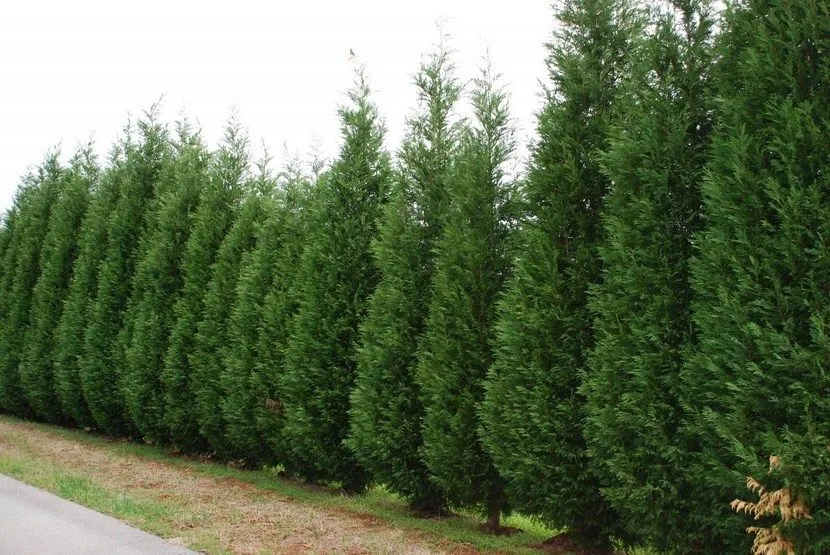
For a long time, I associated it with enormous dark-green walls that block the light and overwhelm everything around them. Then I started seeing Leyland cypress used well: with enough space, controlled height and a clear purpose in the garden.
Today we have Leyland cypress in our own garden, and I understand much better why people choose it when they want to create an evergreen backdrop, privacy and wind protection relatively quickly.
With Leyland cypress, the problem is rarely just the plant itself. More often, it is the size we have allowed it to reach.
What Is Leyland Cypress?
Leyland cypress, usually known as Leylandii or Leyland Cypress, is a fast-growing evergreen hybrid.
Its rapid growth is one of the main reasons it is so widely used for hedges and privacy screens.
In good conditions, young plants can make substantial annual growth and create useful height relatively quickly.
Why We Chose Leyland Cypress Instead of Thuja
At first, I considered thuja too. It is a logical choice for a formal, relatively narrow evergreen hedge, and there are gardens where it works very well.
For our garden, however, we wanted something with stronger growth and a more natural, tree-like presence.
I wanted the greenery to feel like part of the landscape, rather than simply a row of plants placed along the boundary.
In that respect, Leyland cypress was much closer to what I had in mind.
The two plants have different characters. In a narrower space, or where a more controlled formal hedge is needed, thuja may be the more sensible choice. Leyland cypress needs more planning because of its vigorous growth.
Its Biggest Advantage for Me Is the Way It Creates the Framework of the Garden
There is a huge difference between an exposed open space and a garden that already has an established green backdrop.
Once taller planting develops, it starts to change the way we see everything else.
Leyland cypress does more than hide the edge of a garden. It can become the backdrop against which the entire garden is seen.
Why Do Some Leyland Hedges Look Beautiful While Others Become Overwhelming?
The main reason is size.
Leyland cypress is not a small ornamental shrub. If left unrestrained, it has the potential to become a large tree.
When several plants are planted close together and left untrimmed for years, the result can be a very tall and massive evergreen wall.
That is why I think the decision should be made at the planting stage: what height and width do we actually want to maintain?
Pruning Needs to Start Early
This is probably the most important practical point when growing Leyland cypress as a hedge.
I would not wait until the plants have become enormous before trying to control them.
It is much better to build the shape gradually, while the plants are young and there is still active green growth across the outer surface.
I would establish in advance whether I want a two- or three-metre screen, or whether the site genuinely has room for something taller.
This helps the hedge stay dense without developing unnecessary width.
Controlling moderate annual growth is much easier than trying to reduce an old, oversized hedge.
If the hedge is cut hard back into old brown wood, regrowth may be poor and unattractive bare areas can remain.
With regular trimming, we are cutting relatively young growth. With a neglected hedge, there may eventually be nowhere left to cut without reaching old bare wood.
Leyland Cypress vs Thuja - Which Would I Choose?
- very fast growth;
- a stronger, more tree-like presence;
- creates height and privacy quickly;
- better suited to larger spaces;
- requires regular size control.
- generally more moderate growth;
- well suited to a formal appearance;
- creates a uniform evergreen screen;
- can be easier to fit into narrower spaces;
- also needs the right site and sufficient water.
I would not choose between them simply on the basis of which one grows faster.
What matters more is how much space we have, how tall a screen we need and how much maintenance we are prepared to do.
What About Cherry Laurel?
Cherry laurel is a very different alternative because it is a broadleaf evergreen.
Its large leaves create a softer and richer green background, and in some contemporary gardens it can look beautiful.
But here again, I would not say that one plant is automatically better than the other.
In a hot, dry garden, I would think carefully about irrigation and positioning whichever of the two I chose.
Where I Would Use Leyland Cypress Today
For me, its best use is where we genuinely need a green architectural background.
For example:
- along a long boundary in a larger garden;
- to screen neighbouring buildings;
- as a backdrop behind ornamental planting;
- to create a more sheltered garden area;
- where there is enough room to maintain it properly.
I would not squeeze it into a narrow corridor between a fence and the house simply because I wanted a fast green wall.
What I Would Plant with It
I do not like a garden built entirely around one evergreen species.
Leyland cypress works best for me when it remains the background, while the planting in front of it brings different textures and colours.
- photinia;
- flowering shrubs;
- trees with lighter foliage;
- roses and perennials;
- more loosely placed architectural plants.
For me, the best hedge should not be the main character. It should make the rest of the garden look better.
What Are the Disadvantages of Leyland Cypress?
This is not a “plant it and forget it” solution.
What I Learned from the Leyland Cypress in Our Own Garden
More than anything, I learned that an evergreen background plays a much bigger role in a garden than I realized at the beginning.
It is not necessarily the most interesting thing when you look at one plant in isolation. But once it begins to shape the space, flowers, trees and shrubs stand out much more clearly against it.
And that is why I now look at Leyland cypress very differently.
If I needed a fast-growing evergreen screen and had enough space, Leyland cypress is a plant I would seriously consider again.
But I would plant it only if I knew from the beginning what height and width I wanted and was prepared to maintain it.
That, for me, is the difference between a beautiful evergreen background and a hedge that eventually starts controlling the garden instead of serving it.