
Table of Contents
Some plants catch our attention for a few spectacular weeks. Others are the ones whose value we begin to understand only after living with them for a while. Photinia belongs firmly to the second group for me.
I now have five photinias in my garden. Not because I deliberately set out to collect them, but because I gradually started using them as part of the garden's structure.
They provide volume, an evergreen backdrop, red new growth and a strong presence through much of the year. And one of the things I like most is how different they can look depending on the way they are shaped.
Some plants simply fill a space. Others begin to build the garden itself. For me, photinia belongs to the second group.
How I Ended Up with Five Photinias in My Garden
I bought the first one almost by accident. At the time, I was looking for plants that would give the garden more structure and make the overall layout feel more intentional.
I wanted something evergreen, but not a solid green mass that looked exactly the same throughout the year. I wanted volume, colour and character, without adding another plant that constantly demanded attention.
Over time, I realized that this is exactly what makes photinia so useful. It is not simply an attractive shrub. It can become a backdrop, an accent, a screen, a clipped architectural form or even a small tree.
Why Photinia Changes So Beautifully Through the Seasons
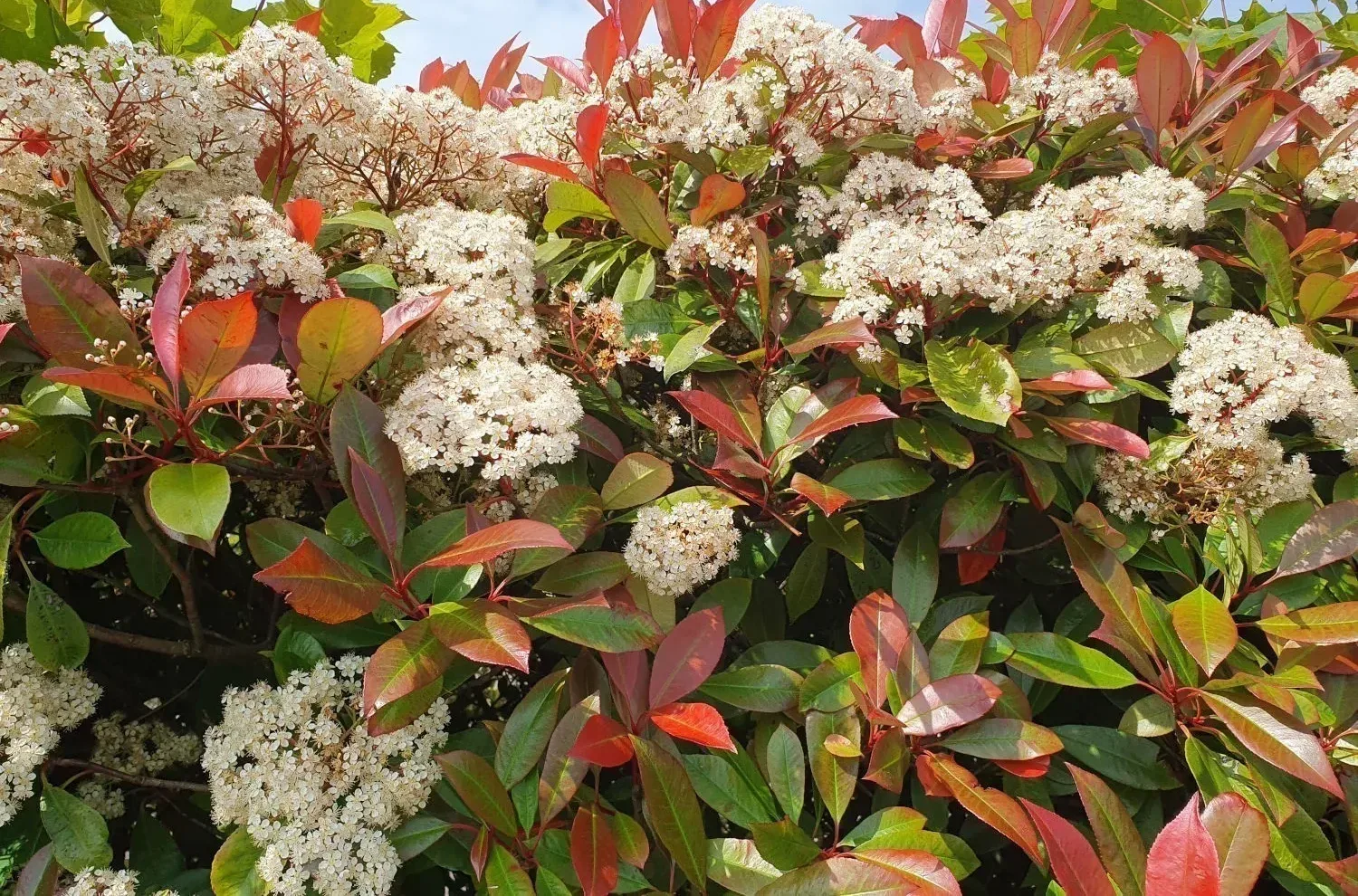
Its most recognizable feature is the new growth. Young leaves emerge in shades of red, copper and burgundy before gradually maturing to a rich green.
This means that several colours can appear on the same plant at the same time. The shrub feels dynamic without looking overly variegated or busy.
Photinia does not look exactly the same throughout the year. That changing character is part of its appeal.
In Spring, the New Growth Becomes the Main Feature
This is when photinia attracts the most attention. Depending on the light and variety, the new leaves can appear bright red, coppery, deep burgundy and sometimes almost pink.
The contrast is especially effective against a darker backdrop, stone, fencing or a relatively simple façade.
I like the fact that the colour comes from the foliage rather than from a short flowering period. The effect lasts longer and is much easier to integrate into the overall garden composition.
Photinia stands out especially well against stone, concrete, simple façades, dark fencing and plants with quieter foliage.
In Summer, You Begin to Appreciate the Structure More Than the Colour
The red spring growth is the obvious visual moment, but summer reveals another quality: photinia helps hold the garden together.
Once some flowering plants have finished and summer heat begins to change the overall appearance of the garden, a stable evergreen shrub provides background and volume.
This is particularly useful in a garden with many seasonal plants. They flower, change and disappear, while photinia remains part of the underlying structure.
Why I Have Five Photinias
The reason is simple: I began using them as architectural elements, rather than treating them as five identical shrubs.
Pruning Is What Keeps Photinia Dense and Well Shaped
If it is left unshaped for a long time, photinia can become more open, develop long shoots and gradually lose its compact appearance.
Moderate pruning encourages branching and usually produces more fresh growth. And it is that fresh growth that carries the characteristic red colour.
Shapes I Particularly Like- a natural but dense shrub;
- a more clearly rounded shape;
- looser cloud-like forms;
- photinia trained as a small standard tree.
The last option is especially useful when you want evergreen foliage and colour without creating a heavy mass of shrubbery close to the ground.
The aim is not to cut the plant constantly. The idea is simply to shape it enough to maintain density and the size you want, without turning it into a shrub that exists only to be clipped.
Photinia as a Hedge
Yes, photinia can also be used as a hedge. For me, it is one of the more interesting options when you want an evergreen screen without creating a completely uniform green wall.
The new growth brings seasonal colour, while regular shaping allows the hedge to remain reasonably dense.
- very consistent colour;
- a clearly defined green wall;
- less seasonal change;
- a strong structural presence.
- red new growth;
- more visible seasonal change;
- a softer broadleaf appearance;
- more flexibility in the way it can be shaped.
Which option works better depends on the site. I would not automatically replace every hedge with photinia, but when I want more movement and foliage colour, it is definitely a plant I would consider.
What Problems Can Photinia Have?
It is not completely trouble-free. And I think it is much more useful to know that in advance than to describe it as a perfect low-maintenance shrub.
Leaf problems are more likely when the plant becomes too congested, air circulation is poor or the foliage remains wet for long periods.
In deep shade, the decorative effect of the red new growth is also usually much weaker.
Photinia is not a plant you can completely forget about. But the amount of care it needs is relatively small compared with the role it can play in a garden.
Its Biggest Advantage for Me Is the Way It Completes the Garden
This is something that is difficult to notice when we buy plants one at a time.
Some plants give us flowers. Others bring fragrance. Some become obvious focal points.
But a garden also needs plants that connect those elements: plants that provide background, height, volume and a sense of completion.
For me, photinia does exactly that. Perhaps that is why, even though something new appears in the garden almost every year, my five photinias remain among the plants I have never regretted planting.
If you are looking for an evergreen shrub that does not look exactly the same all year, photinia is worth considering. The red new growth provides colour, while the mature green foliage creates structure through the rest of the season.
For me, its real value is not only in its attractive leaves. It is in its ability to work as a background, accent, screen or individual form and to help the rest of the garden feel more intentional and complete.