
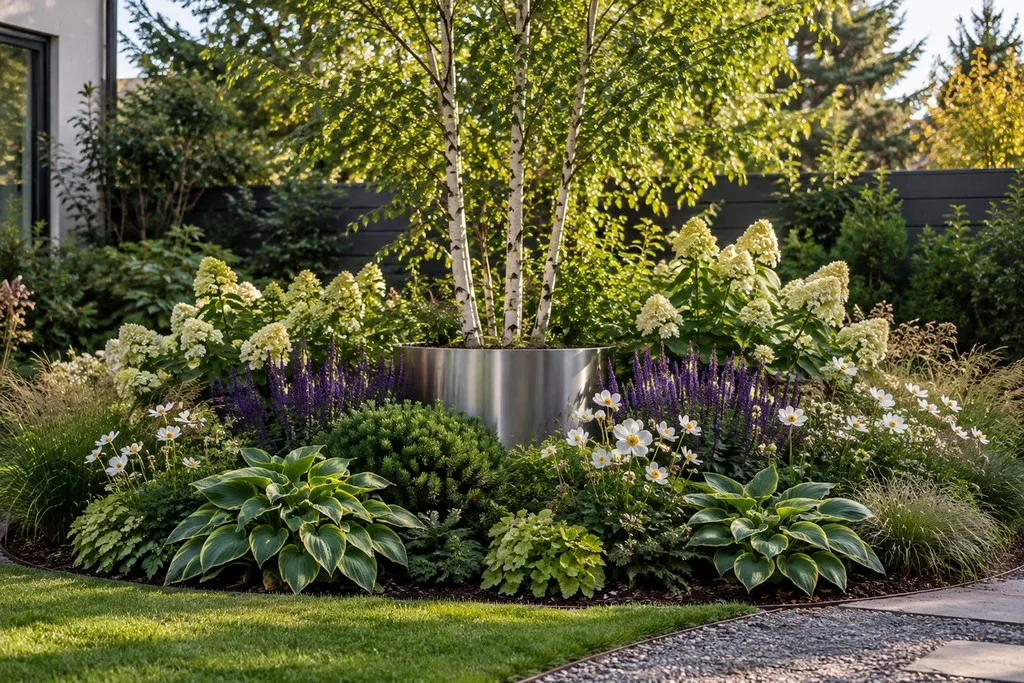
This naturalistic composition with birch shows how a relatively simple planting scheme can create a calm, layered garden with year-round structure. Birch provides height, mugo pine adds evergreen mass, hydrangea brings volume, while salvia, hosta and Japanese anemone complete the seasonal layers.
This is the first garden in the “How It’s Made” series, where we look at professional landscape ideas and adapt them for real home gardens. If you want to understand the thinking behind the whole series, start with our hub on gardens by professional landscape designers.
The planting combination at a glance
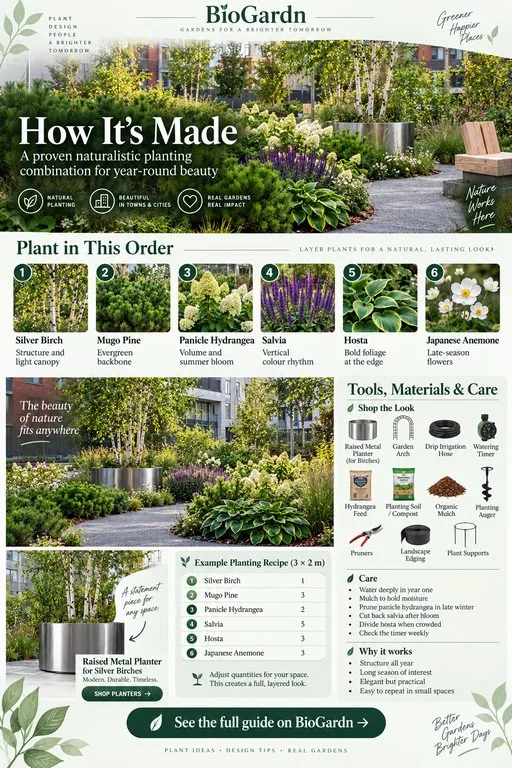
For a compact bed of around 3 × 2 m, the composition can be built around one multi-stem birch, three compact mugo pines, one or two panicle hydrangeas, five salvias, three to five hostas and three to five Japanese anemones. Exact quantities should always be adjusted according to the mature size of the varieties you choose.
The main principle: use only a few plant species, but repeat them in clear groups.
1. Start with the structure
The tallest element is the multi-stem birch. It creates the vertical framework and immediately gives the composition a finished look without making it feel heavy. A multi-stem form works especially well in modern gardens because it lets light pass through and blends naturally with the lower planting.
If the area is paved or you want a stronger architectural effect, the birch can also be grown in a large container, provided the planter is large enough for the root system and suitable for long-term outdoor use.
View on Amazon →
2. Add an evergreen base
Mugo pine is the low structural element that keeps the planting bed visually grounded in winter. Planted in a group of three, it creates a calm evergreen mass that makes the seasonal flowering plants stand out more clearly. This is one of the most useful principles in year-round garden design: part of the composition should remain visible even when herbaceous perennials die back.
3. Build volume with panicle hydrangea
Hydrangea paniculata is the main flowering shrub in this combination. Its large flower heads create a soft, light mass through summer and early autumn, while the gradual change in flower colour extends the seasonal effect. In a small border, one or two hydrangeas are usually enough.
Place them behind the lower perennials and leave enough space for their mature width. A good planting design should look convincing after several years, not only on the day it is planted.
For supporting flowering and root development.
View on Amazon →
4. Create vertical rhythm with salvia
Salvia nemorosa visually connects the composition. Its upright purple flower spikes contrast beautifully with the rounded hydrangea blooms and the compact evergreen shape of the mugo pine. Instead of planting individual salvias here and there, plant them as one repeated group.
Five plants are often enough in a small bed to create a clear block of colour. After the first flush of flowers, salvia can be cut back, which may encourage fresh growth and another round of bloom in suitable conditions.
5. Soften the front edge with hostas
Hostas add a completely different texture. Their broad leaves calm the composition and balance the finer flower spikes of salvia and anemones. Place them in the shadier part of the bed, where the birch or hydrangea provides some protection from strong sun.
This is also an important design lesson: not every plant has to flower. Foliage can be just as important as flowers when building a strong planting composition.
6. Extend the season with Japanese anemones
Japanese anemones take over toward the end of summer and into autumn, when some of the earlier plants begin to lose their impact. Their light flowers bring movement and help the planting feel less rigid.
Plant them in a group and leave enough room for gradual spread over time.
Why this combination works
The strength of this garden does not come from one spectacular plant, but from the way the different roles are distributed. Birch creates height, mugo pine provides evergreen structure, hydrangea gives volume, salvia creates vertical rhythm, and hostas and anemones fill the lower and middle layers.
The garden therefore does not depend on one short flowering period. Fresh foliage carries spring, salvia and hydrangea dominate summer, anemones and changing leaves extend the interest into autumn, while birch bark and evergreen pine keep the structure visible in winter.
How to plant it
The garden therefore does not depend on one short flowering period. Fresh foliage carries spring, salvia and hydrangea dominate summer, anemones and changing leaves extend the interest into autumn, while birch bark and evergreen pine keep the structure visible in winter.
How to plant it
Before digging, place all the plants on the soil while they are still in their pots. Start with the birch, then position the mugo pines and hydrangea. Add the salvia, hostas and anemones only after the main structure is in place.
Step back and look at the composition from the main viewpoint. Avoid perfectly even spacing and rigid symmetry. A naturalistic border should feel relaxed, but never random.
Water thoroughly after planting and mulch the open soil. During the first year, regular watering is especially important while the plants establish strong root systems.
What you will need
You do not need a long list of equipment to build this planting bed. A few well-chosen tools and systems, however, can make both planting and long-term maintenance much easier.
A practical option for consistent watering in a densely planted bed, especially during hot weather or holidays.
View on Amazon →
Useful when planting multiple perennials quickly and evenly.
View on Amazon →
For seasonal pruning of hydrangea, salvia and general maintenance.
For keeping a clean line between the planting bed, lawn and paving.
About mulch
Mulch helps conserve moisture, reduce weeds and visually tie the planting together. For this type of garden, a simple organic bark mulch is usually more suitable than highly decorative material.
The orchid bark product below can work as a bark-based material in some container or soil-mix uses, but for a full garden bed I would normally choose a product specifically labelled for landscape or flower-bed mulching.
Useful mainly for container mixes or as a bark amendment rather than as the primary mulch for a large border.
View on Amazon →
Basic maintenance
Once established, this combination does not require complicated care. Panicle hydrangea can be pruned in late winter or early spring, salvia can be cut back after the first flowering, and hostas can be divided when they become too crowded. Mulch can be topped up when necessary, and the planting should be checked from time to time to make sure stronger plants are not overwhelming slower-growing neighbours.
A well-designed perennial border should become more convincing as it matures. That is why it is important to leave enough room from the beginning for the plants to reach their real size over the next few seasons.
A ready-made idea that can still be adapted
You do not have to copy this planting combination plant for plant. The more important part is to keep the structure: one light tree, a compact evergreen base, one main flowering shrub, upright perennials and a layer of broader foliage in the foreground.
That is the idea behind “How It’s Made”: not to copy professional gardens blindly, but to understand why they work and then use the same design logic in your own space.