
As an Amazon Associate, BioGardn earns from qualifying purchases at no additional cost to you.
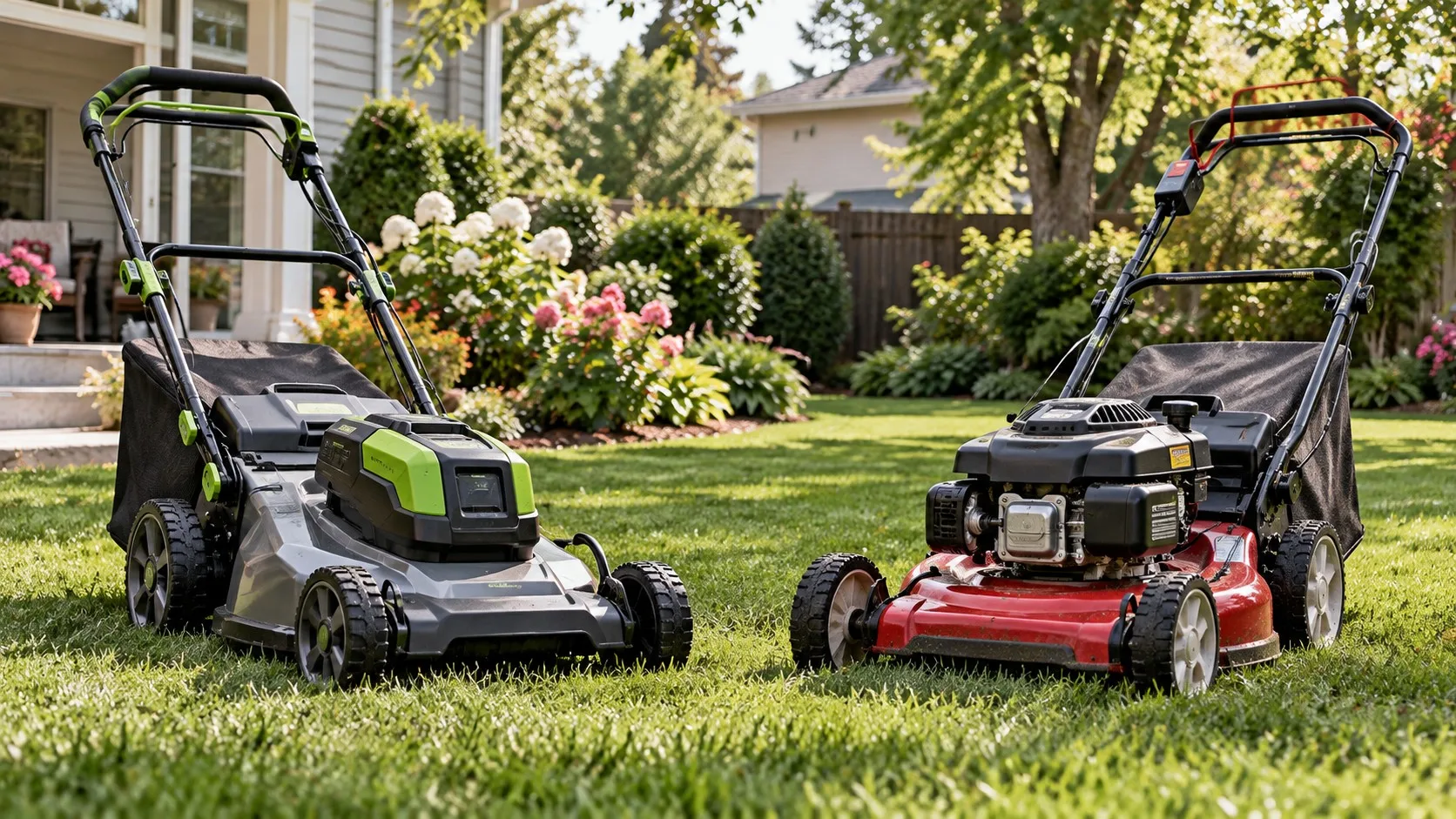
A battery mower sounds great until you picture the battery dying halfway across the backyard.
That is still the question many homeowners ask before giving up gas: Will one charge actually finish my lawn?
The answer depends less on marketing claims and more on your yard size, grass conditions, terrain, mowing speed, and battery capacity. For many suburban lawns, a modern cordless mower can absolutely replace gas. For larger properties or heavy mowing conditions, gas can still be the simpler choice.
Quick Answer: Gas or Battery for Your Yard?
Small Yard — Battery Makes the Most Sense
If you are mowing a typical city or small suburban lawn, a quality cordless mower usually gives you plenty of runtime without gas, oil, pull cords, or engine maintenance.
Around 1/2 Acre — Battery Can Work Very Well
This is where battery size matters. A mower like the RYOBI 40V HP is specifically positioned for lawns up to about half an acre, while larger-capacity systems such as EGO give you more runtime flexibility.
Large Yard or Heavy Grass — Gas Still Has an Advantage
If you regularly mow thick growth, wet grass, slopes, or a larger property, a gas mower gives you continuous operation as long as you have fuel.
Already Own Cordless Yard Tools?
If you already have EGO, RYOBI, or another compatible battery platform in the garage, staying within that ecosystem can make a battery mower much more attractive.
Will a Battery Mower Finish Your Lawn on One Charge?
Sometimes yes — and sometimes that is the wrong question.
Manufacturers publish runtime under controlled conditions. Your actual mowing time depends on what the mower has to do.
A flat lawn that is mowed every week puts much less load on a motor than tall spring grass, thick St. Augustine, wet clippings, hills, or repeated self-propel use.
That means a mower rated for 45 or 60 minutes does not guarantee exactly 45 or 60 minutes every time you mow.
Think in terms of yard workload, not just minutes. A smaller regularly maintained lawn may be easy to finish on one pack. A larger lawn with heavy growth may need a second battery even if the square footage looks reasonable on paper.
Battery Mower Runtime: 1/4 Acre vs. 1/2 Acre vs. 1 Acre
About 1/4 Acre
For most homeowners, this is where battery mowing is easiest to recommend.
A quality 40V or 56V mower should have more than enough capability for a typical quarter-acre property under normal mowing conditions.
You also benefit from the things battery owners tend to appreciate most: push-button starting, quiet operation, no gasoline storage, and very little routine engine maintenance.
Around 1/2 Acre
This is where you should pay close attention to the exact battery included with the mower.
RYOBI rates its current 40V HP 20-inch self-propelled mower for up to 45 minutes of runtime with a 6Ah battery and describes it as ideal for half an acre or less.
EGO states up to 60 minutes from its 21-inch self-propelled mower when paired with the recommended 56V 7.5Ah battery.
That makes half-acre suburban properties realistic territory for modern battery mowers, but terrain, grass density, self-propel use, and mowing frequency still matter.
Around 1 Acre
This is where I would stop assuming that one battery is enough.
You may absolutely mow a larger property with cordless equipment, but a second high-capacity battery — or a mower kit built around multiple batteries — becomes much more important.
If you want to mow continuously without thinking about charging or battery rotation, gas remains very practical for larger lots.
Gas vs. Battery Lawn Mowers: Side-by-Side
| Feature | Battery Mower | Gas Mower |
|---|---|---|
| Starting | Push button | Pull start or electric start |
| Noise | Much quieter | Louder engine noise |
| Routine maintenance | Low | More engine maintenance |
| Runtime | Limited by battery capacity | Refuel and continue |
| Heavy mowing | Strong models perform very well | Still excellent for long, demanding sessions |
| Storage | Often folds vertically | Depends on model; some also offer vertical storage |
| Fuel / energy | Recharge battery | Gasoline |
| Best fit | Small to medium suburban yards | Long mowing sessions and larger properties |
Three Mowers Worth Comparing
EGO POWER+ 21-Inch Self-Propelled — Best Battery Choice for Most Yards
EGO has become one of the most recognizable names in premium cordless outdoor equipment, and its 21-inch self-propelled mower shows why.
The mower offers up to 60 minutes of runtime with the recommended 56V 7.5Ah ARC Lithium battery.
It also has variable-speed self-propel, six cutting-height positions, mulching, bagging, and side discharge.
Best for: homeowners who want to replace gas without giving up a full-size 21-inch mower.
What stands out: long stated runtime, mature 56V battery ecosystem, easy starting, and compact storage.
What to know: high-capacity replacement batteries are expensive, so compare complete kit prices rather than looking only at the bare tool.
Check EGO 21-Inch Self-Propelled Mowers on Amazon →
RYOBI 40V HP 20-Inch Self-Propelled — Best for a Typical 1/2-Acre-or-Less Yard
RYOBI makes a lot of sense for homeowners who already use its 40V outdoor tools.
The current RY40HPLM07 series delivers up to 45 minutes of runtime with one 40V 6Ah battery, and RYOBI positions it for lawns up to about half an acre.
The 40V platform also covers dozens of other outdoor tools, which means the mower battery is not necessarily a one-purpose purchase.
Best for: small-to-medium suburban yards and homeowners already invested in RYOBI 40V.
What stands out: practical battery ecosystem, self-propelled rear-wheel drive, and a price below many premium cordless systems.
What to know: if your lawn takes longer than the rated runtime under heavy conditions, a second battery makes ownership much easier.
Check RYOBI 40V Mowers on Amazon →
Toro Recycler Max 22-Inch Gas — Best Gas Reference for Long Mowing Sessions
There is a reason homeowners have used gas Toro Recycler mowers for decades.
The current 22-inch Recycler Max model 21486 uses a 163cc Briggs & Stratton engine and Toro’s Personal Pace self-propel system.
The practical advantage of gas is simple: when the tank gets low, you add fuel and keep mowing.
There is no waiting for a battery to recharge and no need to buy a second high-capacity battery for a longer session.
Best for: homeowners with larger lawns, long mowing sessions, heavy growth, or anyone who simply does not want runtime to be part of the decision.
What stands out: continuous refueling capability, 22-inch deck, strong traditional mower design.
What to know: gas comes with more noise, fuel storage, exhaust, and engine maintenance than battery.
Check Toro Recycler Gas Mowers on Amazon →
What Happens if the Battery Dies Halfway Through?
This is the scenario that worries buyers most, but it is also easy to solve.
You have three choices:
- Buy a mower with enough battery capacity for your property.
- Keep a second compatible battery charged.
- Use batteries you already own from the same yard-tool platform.
For someone already using EGO or RYOBI blowers, trimmers, or hedge tools, that third option can change the economics completely.
A second battery is much easier to justify when it also powers several other tools around the yard.
Which Handles Thick or Wet Grass Better?
Gas used to have an obvious advantage here. The gap is much smaller now.
Modern brushless battery mowers can increase power automatically as grass gets heavier, and premium cordless machines have more than enough torque for normal residential mowing.
But difficult conditions still use more energy.
If you let the lawn grow too tall, mow while it is wet, use self-propel continuously, or tackle steep slopes, battery runtime will drop.
A gas mower also has to work harder in those conditions — but instead of waiting for a battery, you can simply refuel it.
Battery Cost vs. Gas Maintenance
A cordless mower removes several recurring jobs from your garage routine.
There is no gasoline to store, no spark plug maintenance, no carburetor problems after winter storage, and no engine oil routine on the mower.
But battery ownership has its own cost.
A high-capacity replacement pack can cost hundreds of dollars, and lithium-ion batteries do not last forever.
That is why I would not compare only the mower prices.
Compare the whole ownership system:
- Mower
- Included battery capacity
- Replacement battery cost
- Charger
- Other compatible yard tools
- Gas and engine maintenance over several years
Already Own Cordless Tools? This Can Decide the Winner
If there is already an EGO 56V or RYOBI 40V battery sitting in your garage, switching to a mower in the same platform becomes far more attractive.
You can move batteries between the mower, blower, string trimmer, hedge trimmer, and other tools.
That is one of the biggest practical advantages of cordless outdoor equipment — but only if you avoid buying into five incompatible battery systems.
So, Gas or Battery?
Choose battery if:
- You have a small or medium suburban yard.
- You want quiet mowing and push-button starting.
- You dislike storing gasoline.
- You already own batteries in a compatible yard-tool system.
- You mow regularly instead of letting grass get extremely tall.
Gas still makes sense if:
- You have a larger property.
- You regularly mow for long stretches.
- You deal with heavy, overgrown, or demanding conditions.
- You want to refuel in two minutes and keep working.
- You do not want the cost of additional high-capacity batteries.
FAQ: Gas vs. Battery Lawn Mowers
Can a battery mower really cut half an acre?
Yes. Several current cordless mowers are designed specifically for that size range. Battery capacity, terrain, grass height, and self-propel use will affect actual runtime.
How long does a cordless lawn mower battery last per charge?
Current full-size residential models commonly advertise runtimes around 45 to 60 minutes with their recommended batteries, although real-world results vary with mowing conditions.
Do battery mowers have enough power for thick grass?
Good brushless cordless mowers can handle normal thick residential grass very well. Extremely tall, wet, or dense growth increases battery consumption and may require slower mowing or a second pass.
Is gas cheaper than battery?
The purchase price alone does not answer that. Battery mowers have less engine maintenance, while gas mowers avoid the cost of large replacement battery packs. The better value depends on how much you mow and whether you already own compatible batteries.
Should I buy a second mower battery?
If your lawn is near the upper end of the mower’s recommended yard size, a second battery can make cordless mowing much more convenient. It is especially worthwhile if the battery also powers your blower, trimmer, or other yard tools.
The Bottom Line
For the typical American suburban lawn, battery mowers have reached the point where gas is no longer automatically the better choice.
If your property is around a quarter acre, a good cordless mower is an easy option to consider.
Around half an acre, battery still works very well — but battery capacity becomes part of the buying decision.
For large yards and long mowing sessions, gas keeps one major advantage: you can refill the tank and keep going.
The real question is not whether battery mowers work. They do. The question is whether the battery system matches the size and workload of your yard.