
As an Amazon Associate, BioGardn earns from qualifying purchases at no additional cost to you.
Some garden tools are perfectly fine to buy cheap. Others are the kind you regret every single time you use them.
A flimsy trowel that bends in clay soil, pruners that crush a rose stem instead of cutting it cleanly, or loppers that flex when you finally reach a thicker branch can turn a ten-minute job into a frustrating afternoon.
You do not need a premium version of everything in the shed. But there are a few hardworking tools where better steel, stronger handles, good ergonomics, and replaceable parts really do make a difference.
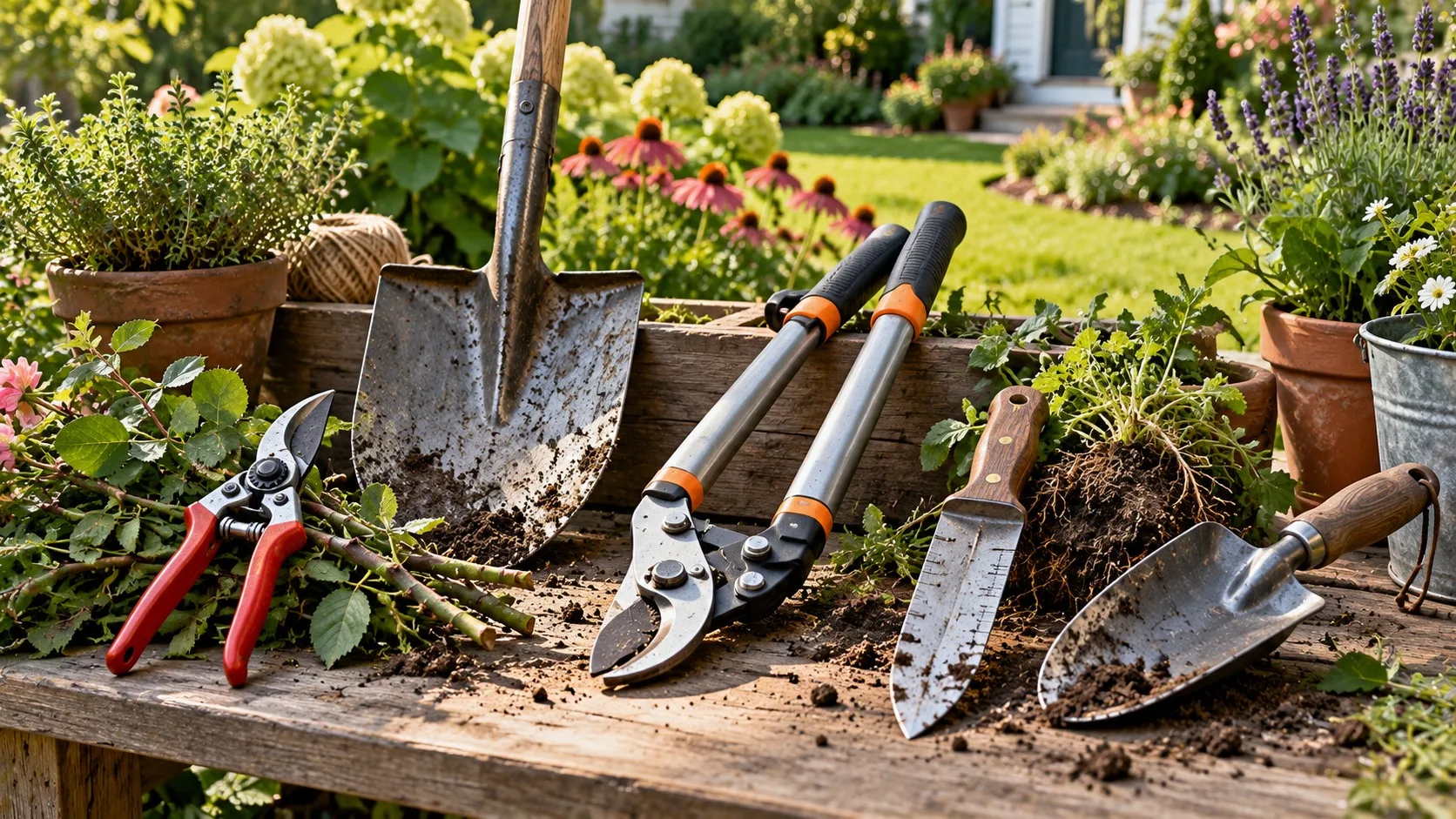
The Short Version: Where Is It Worth Spending More?
1. Pruners
Worth paying more for clean cuts, replaceable parts, and a tool that still feels good after pruning twenty shrubs.
2. A Serious Digging Shovel
If your yard has clay, rocks, roots, or mature landscaping, a stronger shovel earns its keep very quickly.
3. Loppers
Leverage matters. Cheap handles and weak joints become obvious the moment branches get thicker.
4. Hori Hori Knife
One good digging knife can replace several small hand tools for planting, dividing, weeding, and cutting roots.
5. Hand Trowel
A sturdy trowel matters if you regularly work in compacted soil or around established roots.
1. Pruners: This Is Where Cheap Gets Annoying Fast
If you only buy one gardening tool in a genuinely good version, make it your pruners.
They are in your hand constantly: deadheading roses, trimming perennials, cutting small branches, cleaning up shrubs, harvesting flowers, and shaping new growth.
A cheap pair often starts out feeling fine. Then the blade dulls, the pivot loosens, the spring gets sloppy, and instead of making a clean cut, the tool starts crushing stems.
Our Pick: FELCO 2
The FELCO 2 is almost the opposite of a disposable garden tool.
It has forged aluminum handles, a hardened steel cutting blade, replaceable components, and a cutting capacity just under one inch.
The important part is not simply that it is expensive. It is that the tool is designed to be maintained rather than thrown away.
You can replace blades, springs, shock absorbers, and other parts instead of replacing the whole pruner.
Best for: roses, shrubs, perennials, flower gardeners, and anyone who prunes regularly.
Worth paying more because: precision and comfort matter when you use a tool hundreds of times in one season.
2. A Good Shovel: Especially if Your Yard Has Roots or Clay
If your soil is light and loose, almost any decent shovel can move dirt.
The difference becomes obvious when you hit compacted clay, an old shrub root, a patch of gravel, or a perennial that has been growing in the same place for ten years.
This is where thin blades, weak sockets, and flexible shafts stop being bargains.
Our Pick: Radius Garden Root Slayer
The Radius Garden Root Slayer is made for the jobs where a normal shovel starts fighting back.
Its tempered mid-carbon steel blade has a root-cutting profile designed for dense soil, roots, and other difficult material.
Instead of reaching for a shovel, then a saw, then a pry bar, this type of tool lets you dig and cut through smaller roots in the same job.
Best for: transplanting shrubs, dividing established perennials, digging in clay, and working around tree roots.
Worth paying more because: a shovel takes more leverage and abuse than almost any other garden hand tool.
Check Radius Garden Root Slayer on Amazon →
3. Loppers: Good Leverage Is Worth Paying For
Pruners are perfect for small stems. Once you move into thicker branches, leverage becomes much more important than hand strength.
This is where bargain loppers can become frustrating.
Weak handles flex. Cheap pivots loosen. Telescoping locks start slipping. And suddenly you are trying to squeeze harder instead of letting the tool do the work.
Our Pick: Fiskars PowerGear2 32-Inch Lopper
The Fiskars PowerGear2 uses a geared mechanism to increase leverage through the toughest part of the cut.
Its bypass blade is designed for branches up to about two inches thick, and the 32-inch handles give you significantly more mechanical advantage than hand pruners.
Best for: shrubs, small tree branches, woody growth, and seasonal yard cleanup.
Worth paying more because: stronger leverage means less wrestling with the branch — and less strain on your hands and shoulders.
Check Fiskars PowerGear2 Loppers on Amazon →
4. Hori Hori Knife: The Hand Tool You May Use More Than Expected
A hori hori looks simple until you start carrying one around the yard.
Then you discover how many jobs it can replace.
You can use it to:
- Dig planting holes
- Cut through small roots
- Remove weeds
- Divide perennials
- Open bags of soil or mulch
- Measure planting depth
- Work bulbs into the ground
Our Pick: Nisaku NJP650 Hori Hori
The Nisaku NJP650 is a classic Japanese-style garden knife with a stainless steel blade, one straight edge, one serrated edge, and depth markings.
That combination is exactly why I prefer a proper hori hori over several little specialty gadgets hanging on the pegboard.
Best for: planting, weeding, bulbs, perennials, dividing plants, and general bed maintenance.
Worth paying more because: this is a multi-purpose tool where blade strength and edge quality matter far more than decorative handles or a fancy tool set.
Check Nisaku NJP650 on Amazon →
5. Hand Trowel: Cheap Ones Bend Exactly When You Need Them Most
A trowel sounds like the last tool worth spending extra money on.
Until you are kneeling beside an established perennial, trying to work through compacted soil and a network of roots, and the blade starts bending backward.
A good hand trowel should feel like a small digging tool — not a large spoon.
Our Pick: Radius Garden Root Slayer Trowel
The Root Slayer Trowel uses a tempered carbon-steel blade with a root-cutting shape and a comfortable grip.
It is particularly useful when working around mature plants where a full-size shovel is too large but a thin trowel is not strong enough.
Best for: transplanting, deep-rooted weeds, established beds, and compacted soil.
Worth paying more because: blade rigidity matters much more than it appears when you are working in real backyard soil rather than loose potting mix.
Check Radius Root Slayer Trowel on Amazon →
3 Cheap Garden Tools That Usually Aren’t Worth It
Not every low-cost tool is bad. But these are the three categories where I would be especially cautious.
1. Ultra-Cheap Pruners With Soft Steel
A cheap pruner can seem like an easy place to save $20 or $30.
The problem is that poor blades do not simply become annoying. They can start crushing plant tissue instead of making a clean cut.
If you prune only twice a year, you may never care.
If you grow roses, flowering shrubs, fruit trees, or cut flowers, you probably will.
Spend more on: good steel, comfortable handles, adjustable tension, and replaceable parts.
2. Thin Stamped-Metal Trowels
These are common in inexpensive gardening kits.
They are usually fine in loose potting mix.
Push one into heavy clay or lever against a root, however, and the blade or neck can bend surprisingly easily.
Save them for: containers and lightweight soil.
For actual digging: buy a thicker forged or carbon-steel hand tool.
3. Very Cheap Telescoping Loppers
The idea sounds great: one compact tool that extends when you need extra reach.
The problem with the cheapest versions is often not the blade.
It is the rest of the tool.
Handles flex. Locks loosen. Extension mechanisms twist. And once you apply serious leverage to a thick branch, every weak point in the design becomes obvious.
If you really need telescoping reach, buy a well-built model. Otherwise, a solid fixed-handle lopper is often the simpler and more durable choice.
Where You Can Save Money
The lesson is not “buy the expensive version of everything.”
There are plenty of gardening products where a basic version is perfectly adequate.
You usually do not need premium pricing for simple plant labels, buckets, basic watering cans, soil scoops, tarps, or other low-stress accessories.
The tools worth paying more for tend to have something in common:
- They cut.
- They carry heavy loads.
- They take leverage.
- They repeatedly contact hard soil or wood.
- You use them for long periods at a time.
That is where better steel, stronger construction, ergonomics, and replacement parts can actually save money over time.
Repairable Tools Beat Disposable Tools
One of the easiest ways to tell whether a garden tool is really “premium” is to see what happens when something wears out.
Can you buy a replacement blade?
Can you replace the spring?
Can you sharpen it?
Does the manufacturer actually support the product five years later?
A $70 tool that you maintain for a decade can be a better value than three $25 tools that eventually end up in the trash.
FAQ: Which Garden Tools Are Worth Spending More On?
Are expensive garden pruners really worth it?
If you prune regularly, yes. Better pruners typically offer cleaner cutting action, better ergonomics, higher-quality steel, and serviceable or replaceable components.
What garden tool should I buy first?
For most gardeners, a good pair of bypass pruners and a sturdy hand trowel will see more use than almost anything else in the shed.
Is a hori hori knife worth buying?
For gardeners who plant, weed, divide perennials, or work with bulbs, a hori hori can replace several smaller single-purpose hand tools.
Should I buy a cheap garden tool set?
It can be fine for occasional container gardening. For tools that will cut branches, dig compacted soil, or take heavy leverage, buying individual better-quality tools usually makes more sense.
What should I look for in garden tools?
Look beyond color and packaging. Pay attention to steel quality, blade thickness, handle construction, ergonomics, warranties, and whether replacement parts are available.
The Bottom Line
You do not need an expensive garden shed.
You need a few good tools in the places where quality actually changes the job.
Spend more on pruners, a hardworking shovel, loppers, a good hori hori, and a sturdy hand trowel.
Save money on the accessories that do not take much abuse.
And whenever possible, choose a tool you can sharpen, repair, or replace parts on instead of throwing the whole thing away.
The best garden tool is not necessarily the most expensive one. It is the one you are still happily using ten years from now.