
Table of Contents
Some plants catch our attention first with their appearance, while others are something we notice before we even understand where the fragrance is coming from.
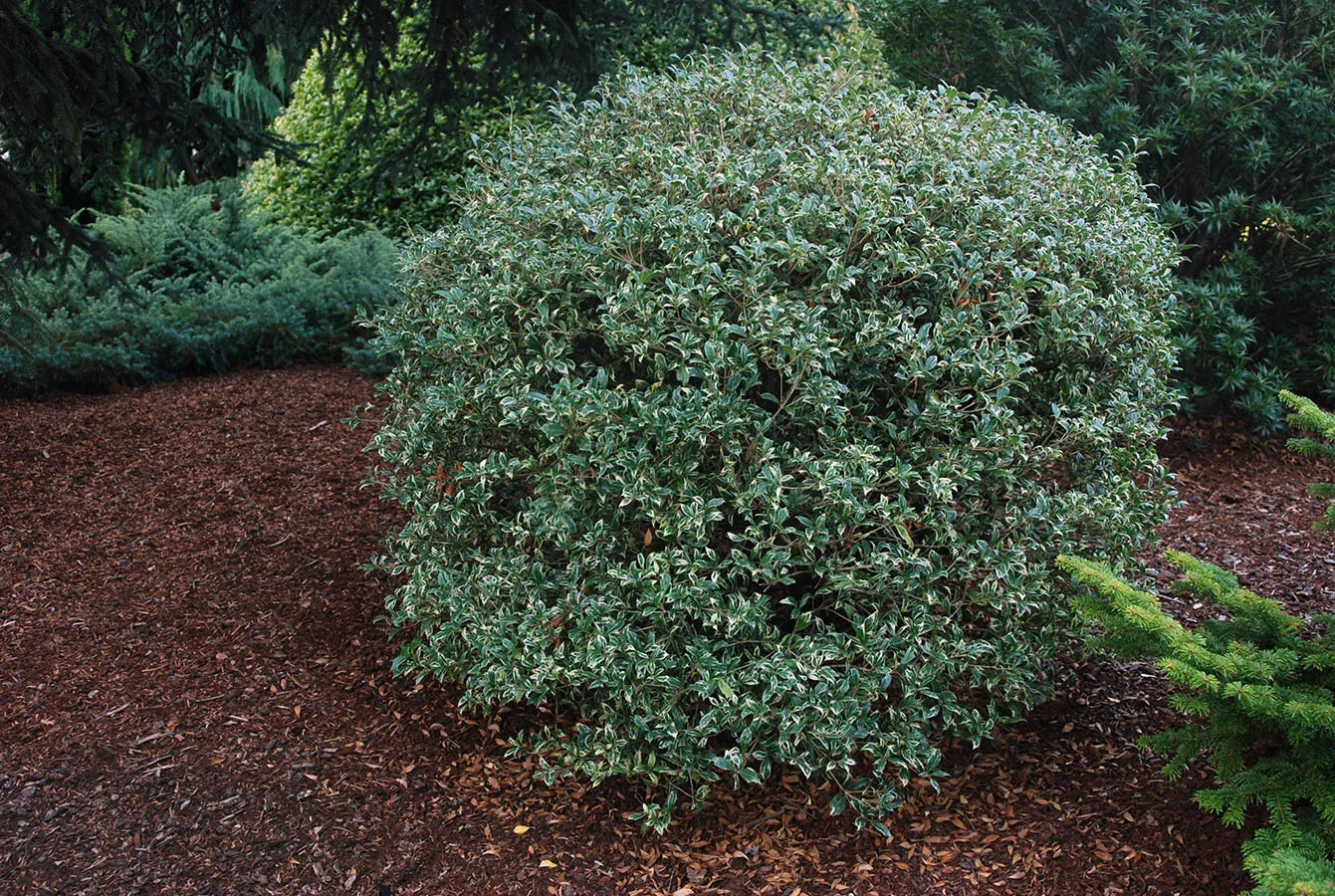
Osmanthus belongs to the second group for me. At first glance, it looks like a calm evergreen shrub with dense dark-green foliage. But when it flowers, its presence changes completely.
It is exactly this combination of discreet appearance and strong fragrance that makes it so interesting to me near terraces, entrances and places where we actually spend time.
With Osmanthus, fragrance is not just an extra feature. It becomes part of the way we experience the space itself.
What Is Osmanthus?
The genus Osmanthus includes a range of evergreen shrubs and small trees. One particularly useful ornamental species is Osmanthus heterophyllus.
It has dense, glossy dark-green leaves, and on some forms the leaf margins can be sharply toothed, giving them a slight resemblance to holly.
As the plant matures, the leaves often become smoother, which changes its appearance and gives the shrub a softer character.
Its Strongest Quality Is the Fragrance
Osmanthus flowers are often small and easy to overlook.
The fragrance, however, can be noticeable well beyond the shrub itself.
It is sweet, warm and distinctive enough to be memorable.
That is why I think of Osmanthus not only as a visual plant, but as part of the way a garden is actually used and experienced.
If fragrance is one of the main reasons I am planting it, I would place Osmanthus where people actually pass or spend time: near an entrance, terrace, path or seating area.
When Does Osmanthus Flower?
Osmanthus heterophyllus usually flowers in autumn, which makes it even more interesting.
This is a time when many of the typical fragrant garden plants have already finished.
The small pale flowers can appear almost unnoticed along the stems, but their fragrance reveals them immediately.
I like plants that offer something interesting just as the season begins to quiet down. Osmanthus is one of them.
Where Osmanthus Grows Best
I would choose a sheltered position in sun or partial shade with well-drained soil.
In very hot climates, some protection from the strongest afternoon sun can be an advantage.
As with many evergreen shrubs, I would not allow a newly planted Osmanthus to remain dry for long periods.
How Much Cold Can It Tolerate?
Here I would be more cautious than with hornbeam or typical cold-hardy conifers.
Osmanthus heterophyllus is reasonably hardy, but its exact cold tolerance depends on the cultivar, the age of the plant, exposure and the local microclimate.
In a colder garden, I would prefer a site protected from cold winds, especially while the plant is young.
Cold wind, winter sun and frozen soil can dry the foliage. A sheltered position can therefore be just as important as the lowest temperature itself.
Osmanthus or Cherry Laurel - Which Would I Choose?
Both are broadleaf evergreens, but they play their role in very different ways.
- finer foliage texture;
- highly fragrant flowers;
- slower, tidier growth;
- useful near entrances and seating areas;
- a better choice when fragrance is part of the design.
- larger, broader leaves;
- a heavier visual effect;
- builds a dense screen more quickly;
- useful for larger evergreen walls;
- a better choice when rapid density is the priority.
If my goal is a large green screen in a relatively short time, I would consider cherry laurel.
If I want finer structure, fragrance and a plant that will be experienced at close range, Osmanthus is much more interesting to me.
It Grows More Slowly, but That Can Be an Advantage
Osmanthus is not a plant that will fill a huge empty space in one or two years.
But its more moderate growth also means less aggressive maintenance once it reaches the desired shape.
For me, that makes it particularly useful in places where I want tidy evergreen structure without constantly cutting back vigorous new shoots.
How I Would Prune Osmanthus
In general, I would prefer moderate shaping that preserves the natural form of the shrub.
If fragrant flowers are one of the main goals, I would avoid unnecessary hard pruning immediately before the expected flowering period.
I decide whether I want a free-growing shrub, a low evergreen screen or a more formal hedge.
I begin with minimal intervention rather than immediately cutting the whole shrub into a geometric shape.
Regular light shaping is easier than trying to reduce a mature neglected shrub heavily.
I prefer Osmanthus as a dense but living shrub rather than as a completely rigid green cube.
Where I Would Use Osmanthus
I think this plant makes the most sense where we can actually experience it at close range.
- beside the front entrance;
- around a terrace;
- near a seating area;
- along a path;
- as an evergreen background in a smaller space;
- as part of a mixed evergreen planting scheme.
What I Would Plant with Osmanthus
The dark-green foliage creates a very good background for lighter colours and contrasting textures.
- hydrangeas;
- roses;
- white and pale pink flowering plants;
- shrubs with lighter foliage;
- small ornamental trees;
- stone, timber and pale facades.
I would not surround it with too many competing focal points. Part of its appeal is its calm presence.
Some of the most interesting fragrant plants are not the ones that dominate visually, but the ones that simply change how a place feels.
What Are the Disadvantages?
Osmanthus is not a universal answer for every garden.
Why I Would Still Use It
Because it offers something that many typical hedge plants do not: fragrance becomes part of the garden experience itself.
Osmanthus does not need to become enormous or dominate the entire planting scheme.
One well-positioned shrub near a place we use every day can have a greater effect than a whole line of plants that we only see from a distance.
If I were looking for a fast-growing green wall, Osmanthus would not be my first choice.
But if I wanted an evergreen shrub with dense structure, a discreet appearance and fragrance that can be noticed before the flowers themselves, it would be a very interesting option.
For me, that is its strongest quality: it does not try to be the most dramatic plant in the garden. It simply makes the space more pleasant to spend time in.