
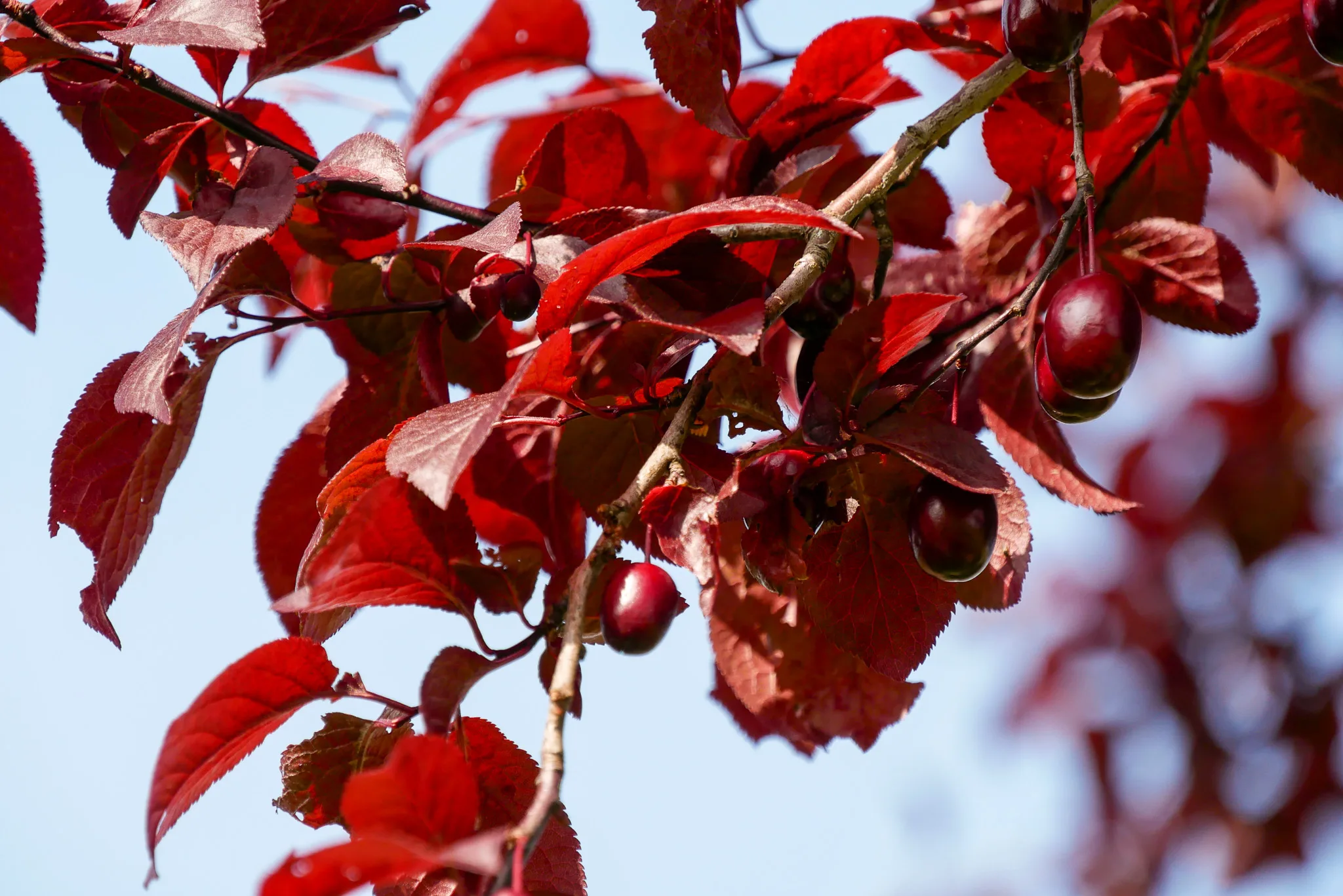
Ornamental plum is one of the most striking small trees for the garden. It flowers beautifully in spring, but its real strength is the dark foliage that remains decorative through much of the season.
In the “Designer Accents in the Garden” series, ornamental plum has a different role from magnolia, Japanese maple or ornamental grasses. Magnolia creates a spring scene, Japanese maple brings finesse, grasses add movement, while ornamental plum brings contrast. It is a tree that is immediately visible in the composition.
Most often, when we talk about ornamental plum, we mean Prunus cerasifera, especially cultivars such as Prunus cerasifera 'Nigra' or 'Pissardii'. They are popular because of their dark purple leaves, pink spring flowers and relatively compact size, suitable for small and medium-sized gardens.
Why Ornamental Plum Is So Valuable
Many ornamental trees are beautiful only for a short time — while they are flowering. Ornamental plum has a longer visual effect because after the spring flowers come the dark leaves. This is exactly what makes it so useful in garden design.
The dark crown creates strong contrast next to light greenery, grasses, stone, a white facade or plants with silvery foliage. In a garden with too much uniform green, ornamental plum brings depth. It works almost like a dark frame in a photograph — it does not need to take up a huge amount of space, but it changes the feeling of the whole scene.
Ornamental plum is one of those trees that does not simply add color. It adds contrast — and without contrast, the garden often looks flat.
It is especially suitable when we want a more modern, more graphic or more dramatic accent. It is not as delicate as an acer, but it is more resilient and easier to fit into many gardens.
How Ornamental Plum Looks Through the Seasons
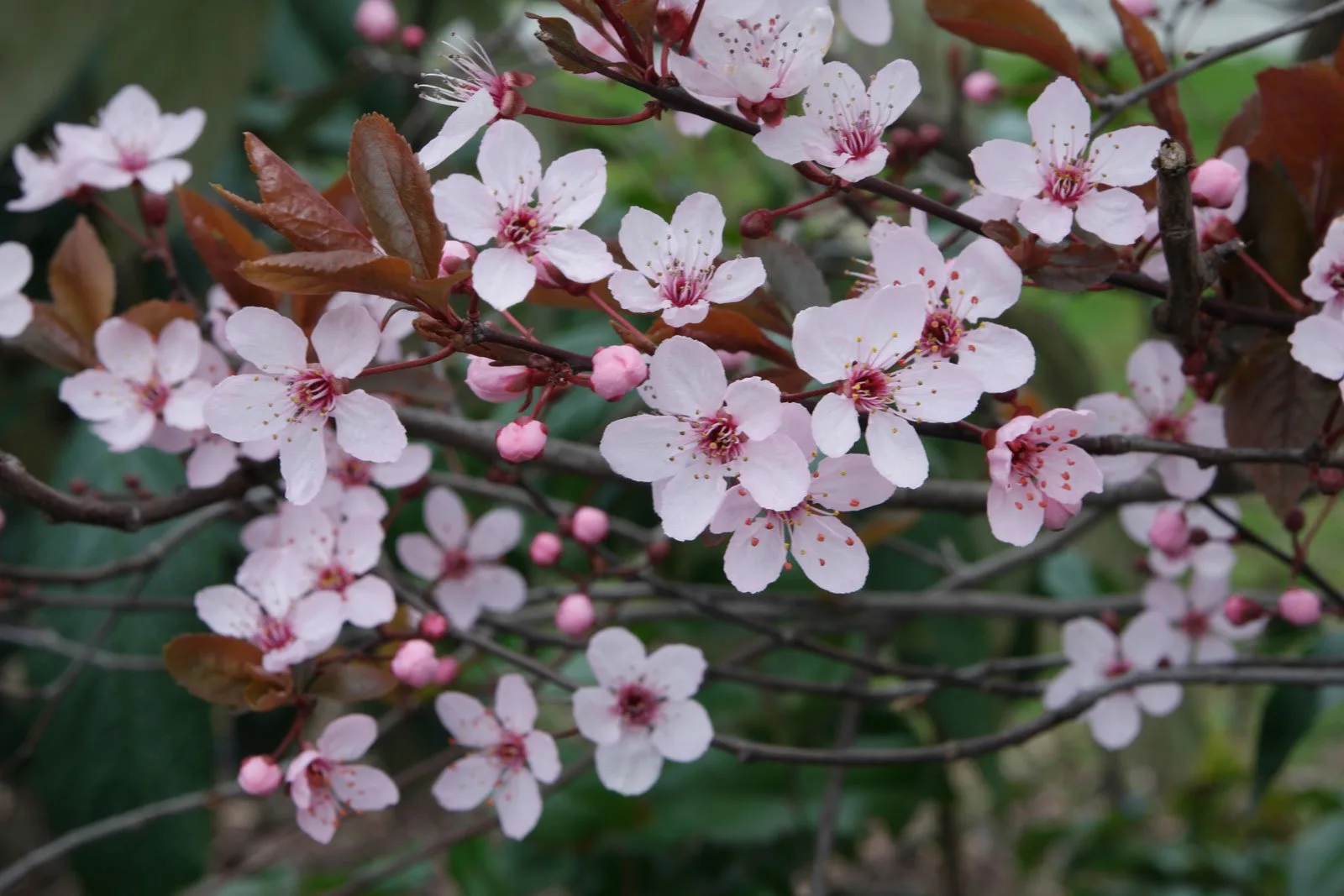
In early spring, ornamental plum flowers with delicate pink to pale pink blooms, often before or together with the new leaves. This makes it very visible at the beginning of the season. The flowers are not as large as magnolia flowers, but they are abundant and create a light spring cloud around the crown.
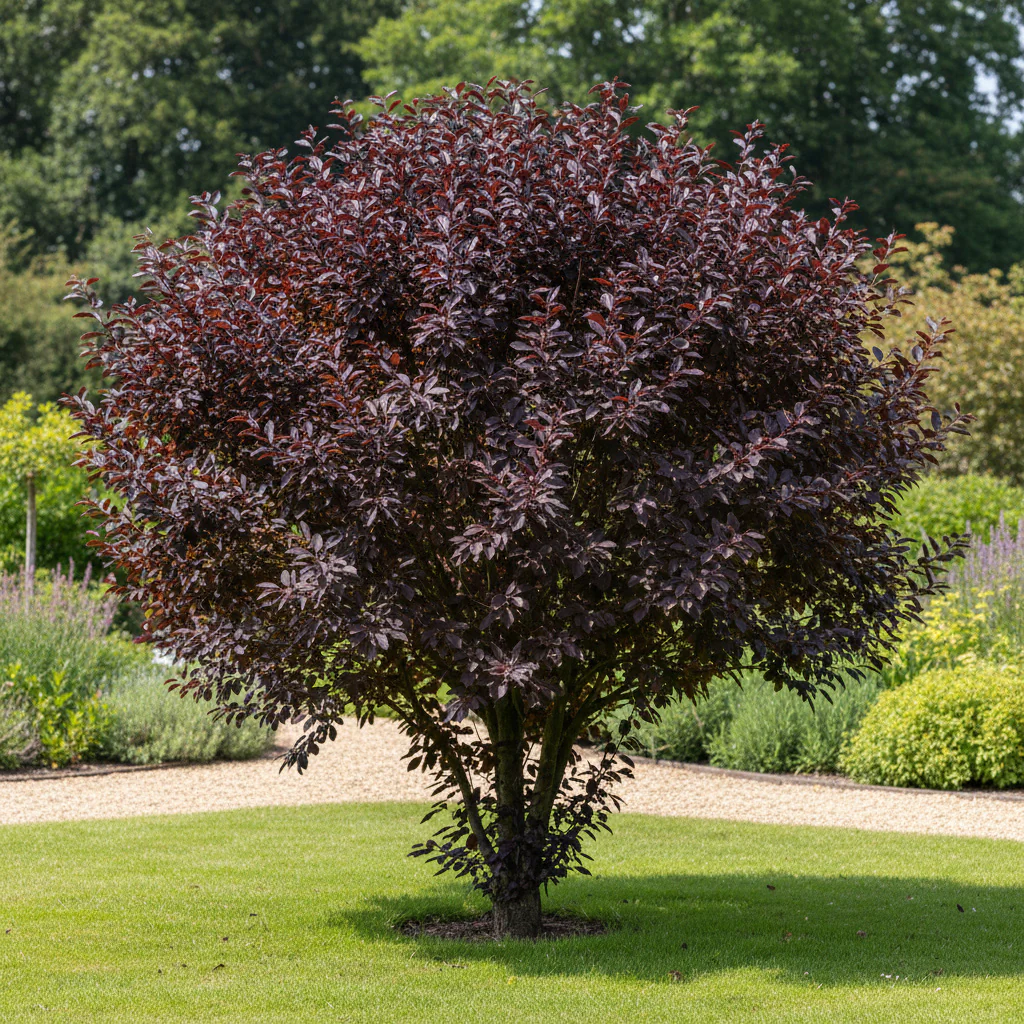
After flowering comes its main decorative effect — the dark foliage. In cultivars such as 'Nigra', the leaves are deep purple to almost black, especially when the tree grows in a sunny place. In summer, the crown becomes dense and contrasting, and in autumn the color may shift toward warmer tones.
Sometimes ornamental plum produces small fruits. They may be reddish or yellowish depending on the cultivar and conditions. In some trees, fruiting is weak; in others, it is more noticeable. If the tree is close to paving, this is something to keep in mind.
Where to Plant Ornamental Plum
Ornamental plum loves sun. The more light it receives, the richer the leaf color becomes. It can grow in partial shade, but the purple color often becomes weaker and the crown looks less expressive.
It looks best as a single accent tree, in the front part of the garden, along a path, next to a light-colored facade, in a lawn or in a mixed ornamental border. It can also be used as contrast next to plants with yellow-green, silver or light green foliage.
It is not a good idea to plant it too close to windows, narrow paths or places where the crown will get in the way later. Young plants look small, but with time ornamental plum develops a broad, rounded crown.
Practical tip: if you want the leaves to stay as dark as possible, choose a sunny place. In shade, ornamental plum loses part of its dramatic effect.
This post contains affiliate links. As an Amazon Associate, I earn from qualifying purchases at no extra cost to you.

A young ornamental plum may need temporary support after planting, especially in an exposed position while its root system is becoming established. If a stake is used, the connection should hold the tree without rubbing hard against the bark.
This soft reusable garden tie can be adjusted around a stake and young stem without using thin wire or a rigid fastening. The support should still be checked regularly and loosened or removed as the trunk grows.
The Most Popular Types and Cultivars
In gardens, the most common ornamental plums are cultivars of Prunus cerasifera — also known as cherry plum or myrobalan plum. The ornamental cultivars are selected mainly for their leaf color and spring flowering.
Prunus cerasifera 'Nigra' is one of the most popular cultivars. It has dark purple leaves, pink flowers in early spring and a rounded crown. It is suitable for small and medium-sized gardens, but enough space should still be allowed for its development.
Prunus cerasifera 'Pissardii' is also a widespread ornamental form with purple foliage. In nurseries, the name is often used for similar dark-leaved plums, so it is worth looking at the actual shape, height and color of the specific plant.
There are also other ornamental members of the Prunus genus, including flowering cherries, almonds and apricots. But ornamental plum stands out with stronger foliage contrast and an easier fit into different garden styles.
| Plant | Main Effect | Where It Works Best |
|---|---|---|
| Prunus cerasifera 'Nigra' | Dark purple leaves, pink spring flowers | Accent tree, small and medium gardens, sunny places |
| Prunus cerasifera 'Pissardii' | Purple foliage and early flowering | Front garden areas, lawns, mixed borders |
| Ornamental cherries | Stronger focus on spring flowering | Japanese-style corners, alleys, more romantic compositions |
| Flowering almond | Low shrub or small tree with early flowers | Small gardens, foreground planting, spring accents |
Soil, Watering and Feeding
Ornamental plum is a relatively adaptable tree. It grows best in fertile, moderately moist and well-drained soil. It does not like constant waterlogging, especially in heavy clay soils where water stays around the roots.
After planting, regular watering is important during the first years. Once rooted, ornamental plum becomes more independent, but during long dry periods it is good to water deeply, especially while the tree is young.
Feeding should be moderate. Too much fertilizer may lead to strong, soft growth, which is not always desirable. It is better to work with compost, mulch and good soil structure.
Pruning Ornamental Plum
Ornamental plum does not require complicated pruning. Most often, dry, diseased, broken or crossing branches are removed. The goal is to preserve the natural rounded shape of the crown without turning the tree into an artificially shaped umbrella.
If pruning is needed, it is usually done after flowering. This way, the spring effect is not removed, and the tree has time to recover its shape during the season. Heavy pruning is not a good idea unless there is a specific problem.
It is important to remove suckers from the base if they appear. They can disturb the shape and take energy away from the main tree.
The Most Common Problems
As part of the Prunus genus, ornamental plum can be prone to some diseases and pests, especially if it is weakened by poor conditions. Problems most often appear in heavy soil, poor air circulation, drought or an overly dense crown.
Leaf spots, aphids, drying of individual branches or problems after mechanical injuries may occur. This does not mean the tree is fussy, but it does mean its general condition should be monitored and stress should be avoided.
What to Combine Ornamental Plum With
Ornamental plum combines very well with light green, silvery and yellowish plants. Contrast is its most important tool. Good partners include ornamental grasses, hostas, lavender, salvia, santolina, low conifers, hydrangeas, white roses, Japanese maple and plants with variegated leaves.
It looks very good next to a light-colored facade or stone paving, because the dark crown stands out clearly. In a modern garden, it can be combined with gravel, wood, concrete and clean lines. In a more romantic garden, it can be used as a background for roses and perennials.
If you already have many plants with dark leaves, use ornamental plum carefully. Too much dark foliage can make the garden feel heavy. One well-placed plum is often stronger than three planted without a clear idea.
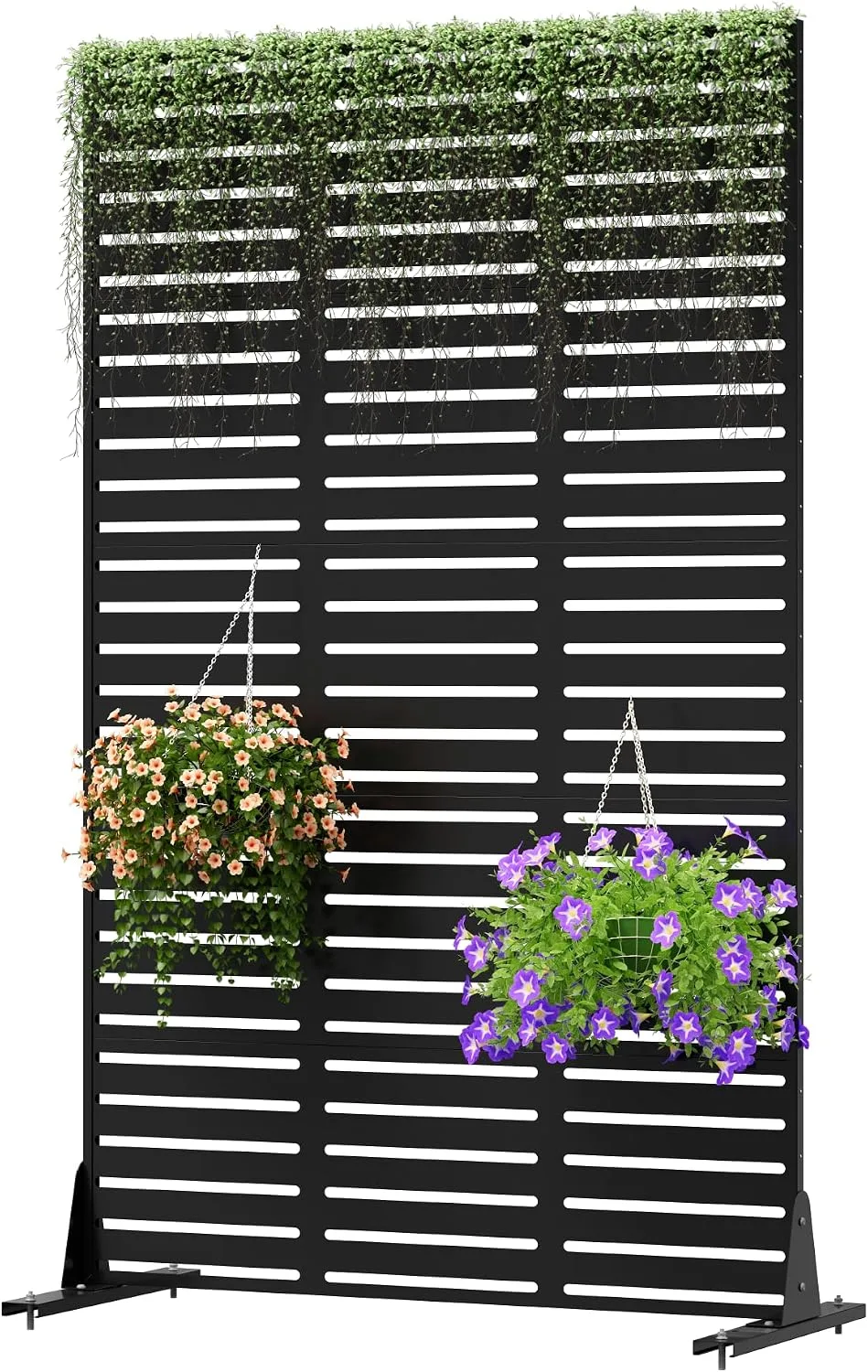
Ornamental plum already creates a strong dark accent, and in a modern garden it can work particularly well as part of a more structured composition with clean architectural elements.
This freestanding metal screen can define a terrace or garden zone while the ornamental plum and surrounding planting soften the hard structure. I would leave enough distance for the tree's mature crown rather than placing the screen tightly against it.
Is It Suitable for a Small Garden?
Yes, but with the right choice of place and cultivar. Ornamental plum is not a giant tree, but it is not a small shrub either. The width of the crown and enough air around it should be planned in advance.
For a small garden, it is best used as a single accent, not as part of an overly dense group. If space is limited, a more compact form or a tree trained on a clear stem may be a better choice, but space still needs to be left for the crown.
Is Ornamental Plum Worth Growing?
Yes, if you want a tree with a clear visual effect that does not rely only on a short flowering period.
Ornamental plum brings spring flowers, dark foliage, strong contrast and a relatively easy fit into different garden styles. It is especially valuable where the garden needs depth and a more expressive structure.
This is a tree for people who want not just greenery, but an accent that can be seen.