
Table of Contents
Some plants catch your attention immediately, while others are something you first notice as part of the overall composition. Cherry laurel belongs to the second group for me.
I began noticing it first in English gardens, then around contemporary houses, hotels and gardens where greenery plays a stronger structural role.
Over time, I understood why it works so well. Its large evergreen leaves create a dense, soft background that does not demand all the attention, but helps the rest of the garden feel more intentional and complete.
Cherry laurel does not necessarily need to be the main feature. Its strength is in the way it connects the space around it.
What Is Cherry Laurel?
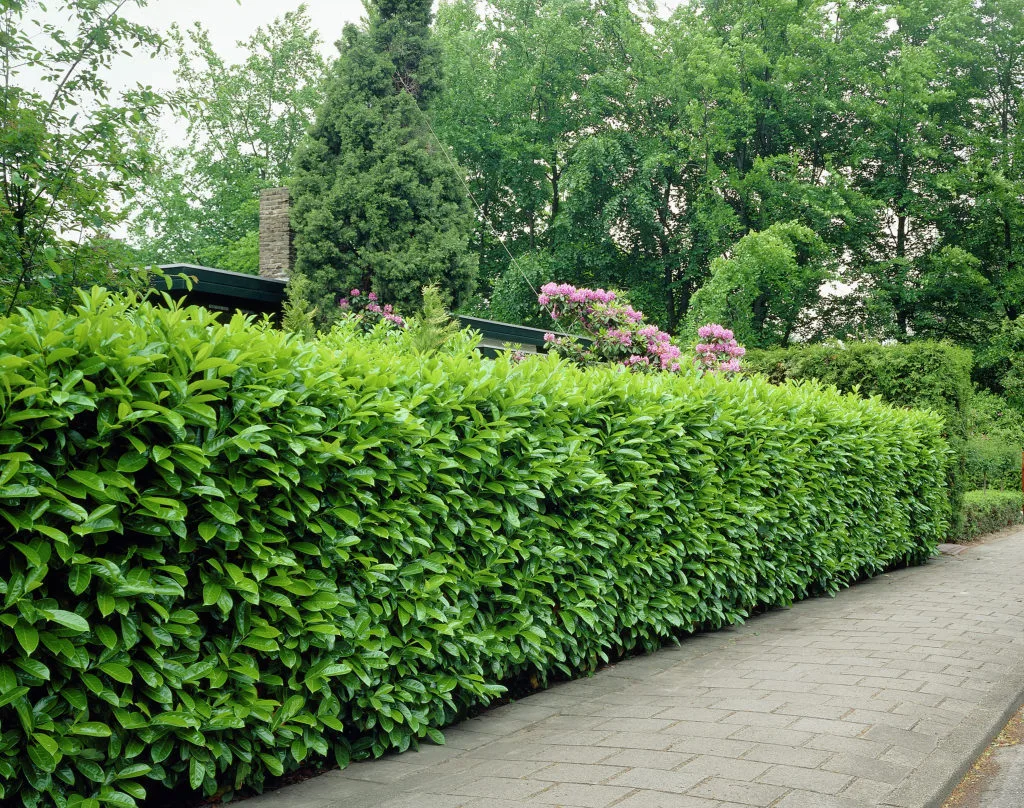
Cherry laurel (Prunus laurocerasus) is a broadleaf evergreen shrub commonly used for hedges, privacy screens and structural planting.
Its most distinctive feature is its foliage: relatively large, dense, dark green and often slightly glossy.
This creates a very different effect from a conifer hedge. The greenery feels softer, leafier and visually closer to a planted garden than to a strict evergreen wall.
Why Cherry Laurel Works So Well in Contemporary Gardens
For me, the reason is the calm background it creates.
When a house already includes stone, timber, concrete, pale paving or clean architectural lines, a large mass of green foliage helps soften the space.
Cherry laurel does not create its strongest effect through dramatic flowers or bright colour. Instead, it works through volume, texture and consistency.
When the background is calm, the architecture, trees, flowers and individual garden features become much easier to appreciate.
Cherry Laurel Is Particularly Good as a Background Plant
This is one of the reasons I prefer it as a structural plant rather than as a stand-alone ornamental feature.
It can work beautifully behind:
- hydrangeas;
- roses;
- flowering perennials;
- trees with lighter foliage;
- architectural plants;
- looser mixed shrub planting.
Used this way, the evergreen foliage does not compete with the other plants. It makes them stand out.
Good evergreen structure does not always need to attract attention. Sometimes its job is simply to make everything else look better.
Where Cherry Laurel Grows Best
This is the part I consider more important than appearance alone.
Cherry laurel prefers soil that does not dry out constantly, but also does not remain waterlogged around the roots.
It generally grows well in sun or partial shade, although in very hot and dry locations, intense afternoon sun can increase stress on the plant.
In a Hot Garden, Irrigation Matters
In a milder climate, cherry laurel can look almost effortless. In a hot, dry garden, the situation is different.
Its large evergreen leaf area continues to lose moisture during periods when the soil can dry very quickly.
For a newly planted hedge, I would therefore plan reliable irrigation from the beginning rather than waiting until the plants visibly wilt.
Organic mulch around the root zone reduces moisture loss, protects the soil from overheating and reduces competition from weeds.
Cherry Laurel vs Thuja - What Is Actually Different?
For me, the real difference is not which one looks more “luxurious.” It is the character of the foliage.
- large broad leaves;
- a softer, more shrub-like character;
- excellent density;
- combines naturally with flowering plants;
- needs reliable moisture in dry climates.
- finer conifer texture;
- a more clearly formal character;
- easily creates a uniform evergreen screen;
- well suited to more structured designs;
- also needs suitable conditions and sufficient water.
Which one I would choose depends on the style of the garden, the space available and the conditions on site.
Pruning Matters More Than It First Appears
Cherry laurel can be maintained as a relatively formal hedge, although personally I prefer it when some natural movement remains.
There is also a practical reason for this. The large leaves can look torn or ragged when they are cut aggressively with powered hedge trimmers.
On smaller or highly visible hedges, I would prefer to do at least part of the shaping with hand pruners, particularly when I want a cleaner finished appearance.
I would not wait until the hedge becomes much larger than I actually need.
Moderate regular shaping helps the hedge remain dense and even.
In prominent areas, I try to avoid leaving too many large leaves cut in half.
For me, this is when cherry laurel looks its best.
With cherry laurel, a little freedom in the shape often looks better than a perfectly rigid green wall.
How Large Can Cherry Laurel Grow?
This depends greatly on the cultivar.
That is why I would not buy a plant labelled simply “cherry laurel” without checking the exact variety and its expected mature size.
There are relatively compact forms as well as much more vigorous cultivars. The difference matters when the hedge is close to a path, house, fence or in a smaller garden.
It is much more sensible to choose a cultivar whose natural height and width are reasonably close to what we need than to spend years fighting a plant that wants to become much larger.
What Does Cherry Laurel Look Like in Winter?
The major advantage is that the green foliage remains.
But those evergreen leaves are also exposed to winter sun, wind and drying conditions.
After a harsher winter, some leaves may turn brown or look damaged, particularly in exposed positions.
This does not necessarily mean that the entire plant has died. Once spring growth begins, and damaged material is cleaned up moderately, the hedge can often recover and fill out again.
Where I Would Use Cherry Laurel Today
Mostly in places where I want a dense green framework without the typical character of a conifer hedge.
- around a seating area;
- to soften or hide a fence;
- as a background behind ornamental planting;
- to separate different areas of the garden;
- in a contemporary garden with stone, timber and clean lines;
- in a more romantic garden as a permanent green background.
What I Would Plant in Front of It
The dark green foliage makes an excellent background for plants with lighter colours, flowers or contrasting structure.
- hydrangeas;
- roses;
- peonies;
- flowering perennials;
- shrubs with lighter foliage;
- small ornamental trees.
This allows cherry laurel to remain the background rather than becoming the only plant we notice.
What Are the Disadvantages?
I would not describe cherry laurel as a plant for every site or as completely maintenance-free.
Why I Still Like Cherry Laurel So Much as a Garden Plant
Because it has the ability to make a space feel calmer.
Not every plant in a garden needs to be spectacular on its own.
Some plants need to create the background, volume and boundaries against which everything else can stand out.
Cherry laurel can do exactly that, and for me, that is where its real strength lies.
If I wanted a dense evergreen hedge with broad leaves and a softer character, cherry laurel would definitely be one of the plants I would consider.
But I would choose the cultivar according to the actual space, provide sufficient water and would not assume that every hot, dry or windy garden is equally suitable for it.
In the right conditions, it can become that calm green background that does not dominate the garden, but makes the whole space feel more complete.