
Table of Contents
Some plants make their strongest impression in spring, while others wait until the garden has almost lost its colour before showing what they can really do.
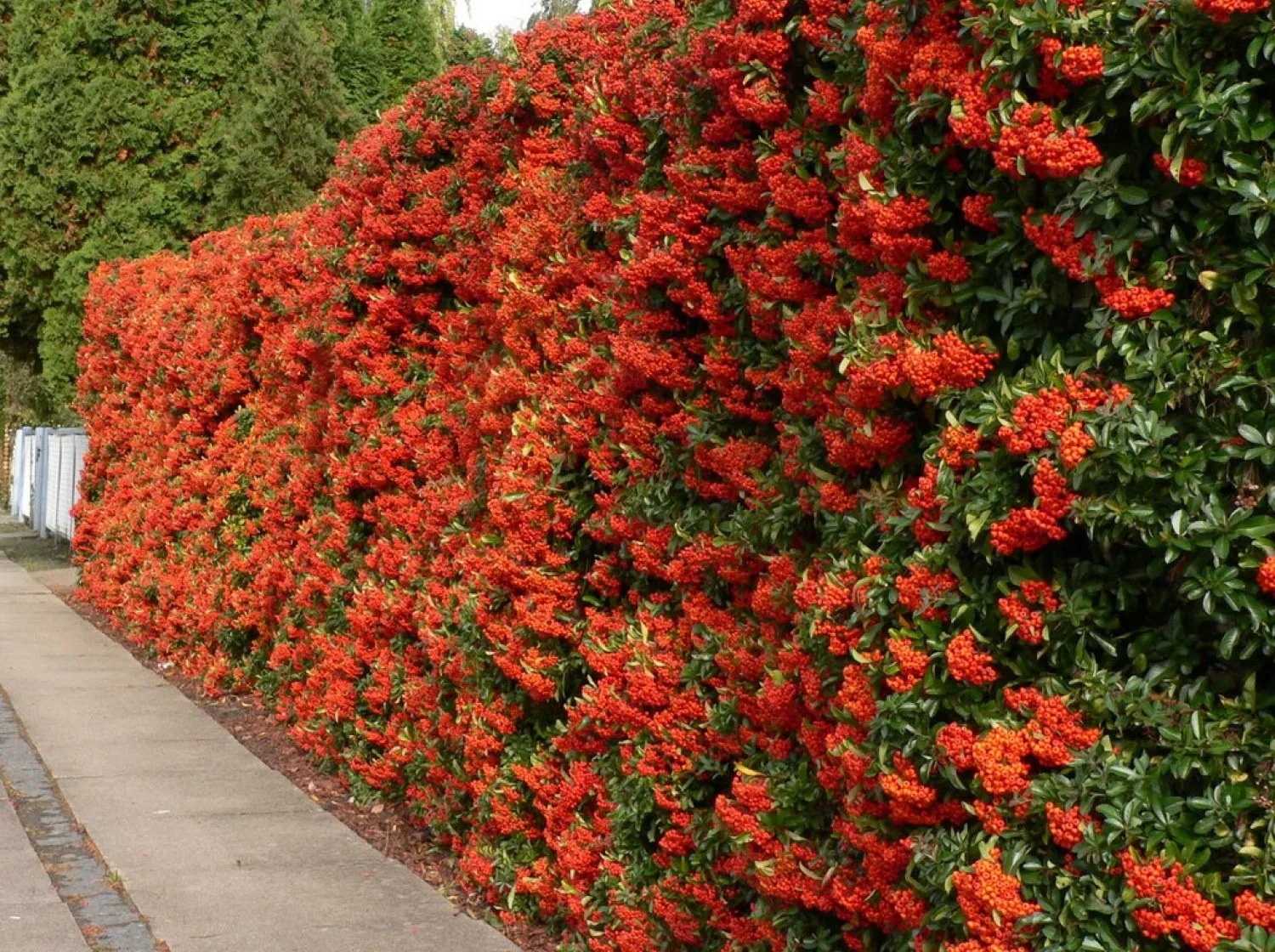
Pyracantha is exactly that kind of plant for me. For much of the year, it can look like a dense, fairly quiet shrub. But in autumn and winter, the bright berries completely change its presence.
That is when I began to appreciate it much more: not only as a hedge, but as a plant that brings colour and structure at a time when many others have already faded into the background.
The real strength of Pyracantha is not only its colour, but the season in which that colour appears.
What Is Pyracantha?
Pyracantha, commonly known as firethorn, is a thorny shrub that can be evergreen or retain much of its foliage through winter, depending on the species and climate.
In spring, it produces masses of small white flowers, followed gradually by its characteristic ornamental berries.
The berries can be:
- yellow;
- orange;
- orange-red;
- deep red.
The exact colour depends on the species and cultivar.
Why Pyracantha Is So Valuable in Winter
In many gardens, winter reveals how little structure and seasonal interest we have actually planned.
Flowering has ended, many perennials have disappeared, and deciduous trees have lost their leaves.
This is exactly when Pyracantha can bring a strong burst of colour without relying on summer flowers at all.
The berries look particularly beautiful against a quiet winter background, while frost, mist and low winter sunlight can make their colours appear even stronger.
Pyracantha is one of those plants that reminds us a winter garden can still have colour.
The Berries Attract Birds, but They May Not Last All Winter
This matters, because we often see photographs of shrubs completely covered in berries throughout winter.
In a real garden, some of those berries may disappear much earlier.
Birds use them as a food source, particularly when other food becomes more limited.
I do not see that as a disadvantage. Quite the opposite: the plant begins to play an ecological role in the garden as well.
How long the berries remain depends on the cultivar, the weather and how quickly the birds discover them.
The Thorns Are Part of Pyracantha’s Character
This is not a soft shrub that I would plant anywhere.
The branches are thorny, and that is exactly what makes Pyracantha so useful in places where we want both an ornamental plant and a physical barrier.
Where Pyracantha Grows Best
For good berry production, I would choose a position with plenty of light.
Pyracantha can also grow in partial shade, but in brighter conditions I would generally expect stronger flowering and heavier berry production.
It is fairly adaptable when it comes to soil, but as with most garden shrubs, I would avoid permanently waterlogged ground.
Pruning Determines How Many Berries You Get
This is probably the most important practical point with Pyracantha.
If I prune it constantly simply to create a perfectly geometric green wall, I may remove some of the flowering and fruiting growth.
So I would decide in advance what matters more: absolute shape or strong seasonal interest.
Those flowers are what will later become berries.
I shape the shrub without cutting it completely mechanically.
If berries are the goal, pruning needs to take fruiting growth into account.
This is one plant where the thorns are definitely not just an ornamental detail.
If I want a really strong autumn and winter display, I would keep the shrub a little looser and prune more selectively.
Pyracantha or Thuja - They Serve Different Purposes
I would not compare them as two versions of the same kind of plant.
They solve different problems in the garden.
- strong seasonal interest;
- flowers and ornamental berries;
- attracts birds;
- thorny defensive structure;
- a looser, more natural character.
- consistent evergreen mass;
- easily creates a formal screen;
- more uniform structure;
- no ornamental berries;
- useful when seasonal change is not the main goal.
If I want a uniform evergreen screen, I would consider a typical evergreen hedge.
If I want autumn and winter colour, birds, movement and a more natural character, Pyracantha offers something completely different.
It Can Be Especially Beautiful Against a Wall
For me, this is one of the uses that makes far better use of the plant’s character than a rigid formal hedge.
The long branches can be trained and maintained close to a wall, fence or another vertical surface.
In winter, the berries become much more visible against a quiet background of stone, rendered wall or brick.
With Pyracantha, the background matters. An ordinary wall can become part of the winter composition.
Where I Would Use Pyracantha
For me, it works best where it can have both an ornamental and a structural role.
- against a stone or brick wall;
- along a fence;
- as a loose defensive hedge;
- along a more natural garden boundary;
- as a colourful winter accent;
- in a garden where I want to attract more birds.
Where I Would Not Plant It
The thorns change many of the practical decisions.
I would not place it:
- immediately beside a narrow path;
- where people often pass with hands close to the planting;
- beside a play area;
- where regular pruning would be difficult;
- in a very small space if I had no intention of controlling its growth.
What Are the Disadvantages?
Pyracantha has a lot of character, but that character also comes with a few compromises.
Why I Think Pyracantha Deserves More Attention
Because it brings something that is missing from many contemporary gardens: genuine seasonality.
In spring, it flowers. In summer, it provides green structure. In autumn, the berries begin to develop. And in winter, it can become one of the strongest colour accents in the whole garden.
It is also more than a decorative object. It can provide food and shelter for birds and make the garden feel a little more alive.
If I were looking only for a uniform evergreen background, I would probably choose another plant.
But if I wanted seasonal change, bright berries, natural structure and a plant with real winter presence, Pyracantha would be a very interesting choice.
For me, its greatest strength is exactly this: it becomes most noticeable at the time of year when the garden needs colour the most.