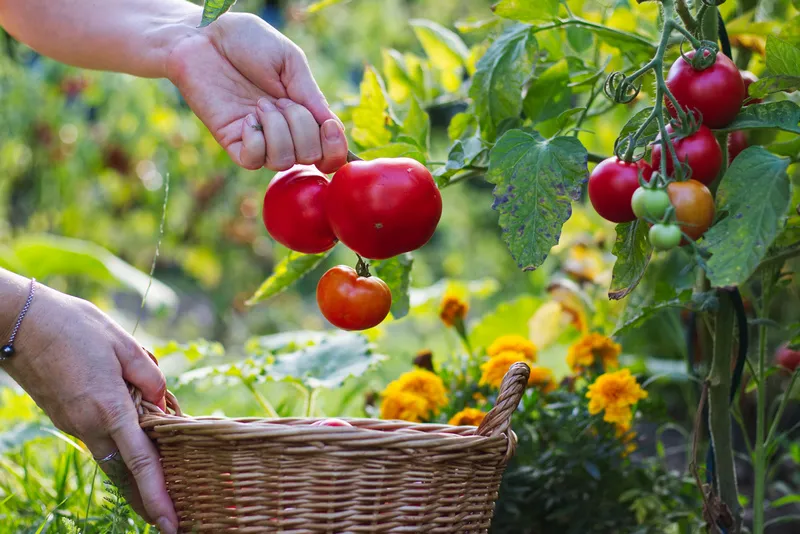
If there is one vegetable we associate most strongly with the home garden, it is the tomato.
Not the cucumber, not the pepper, not the zucchini, however important they may be. Tomatoes are the garden symbol that immediately makes us think of summer, salad, basil, cheese and that unmistakable aroma supermarkets rarely manage to reproduce, no matter how hard they try.
Tomatoes can be grown in the garden, in raised beds and even in large containers on a patio. But to keep the plants healthy and productive, they need a few basic things: sun, good soil, sturdy support, consistent watering and plenty of air circulation.
It sounds like a long list, but the logic is actually quite simple. Tomatoes are vigorous plants, but they do not like chaos.
Plant them too close together, keep the leaves wet, leave them without support and expect them to manage on their own, and sooner or later the familiar garden drama begins: yellowing leaves, disease, cracked fruit, too much foliage and not nearly as many tomatoes as we imagined.
Tomatoes like sun, air and a little order. Give them those things at the right time, and they will reward you generously.
If you are just starting a vegetable garden, it helps to get the basics in place first - location, soil, beds, watering and seasonal care. You may also want to read Vegetable Garden: How to Get Started and Care for It Through the Season .
When and Where to Plant Tomatoes
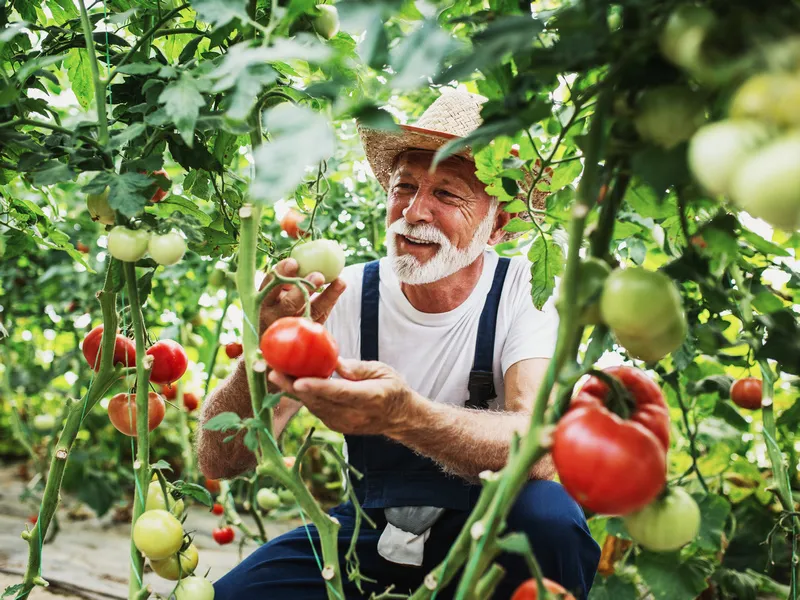
Tomatoes are warm-season plants. They do not like cold soil, late frosts or sudden temperature changes. One of the most common mistakes is planting them outdoors too early simply because the weather has been warm for a few days.
In many temperate climates, tomato seedlings are planted outdoors only after the danger of frost has passed and the soil has warmed sufficiently. Warmer regions can plant earlier, while cooler areas may need to wait a little longer.
Pay attention to soil conditions, nighttime temperatures and the forecast. A healthy seedling planted a week later into warm soil will often establish much better than one rushed into cold ground.
For good fruit production, tomatoes need at least 6-8 hours of direct sunlight each day. In a shady position the plants may still grow, but they are often more elongated, weaker and less productive.
The location should also have good air circulation. That does not mean exposing plants to strong wind, but there should be enough movement of air between them. Crowded plants, especially when the foliage stays wet, are much more vulnerable to fungal diseases.
If tomatoes, peppers, eggplants or potatoes grew in the same bed the previous season, it is better to choose another area if possible. These crops belong to the same plant family and can share some of the same diseases and soil-borne problems.
Soil and Bed Preparation
Tomatoes grow best in fertile, loose and well-drained soil. It should hold enough moisture without remaining waterlogged after every rain or watering.
Before planting, enrich the soil with mature compost or well-rotted manure. Fresh manure should not be placed directly around young plants, because it may damage roots and encourage excessive leafy growth.
Good tomato soil should contain organic matter, structure and air. When conditions are suitable, the root system can grow deeper, helping plants cope better with hot weather and temporary dry periods.
- Add mature compost before planting.
- Loosen heavy or compacted soil.
- Improve clay soil with organic matter.
- In sandy soil, work on improving moisture retention.
- Avoid excessive nitrogen fertilization.
With tomatoes, a good harvest begins before the seedlings ever go into the ground.
Choosing Seedlings and Planting Them Correctly
Healthy seedlings are an important part of a successful start. A good young tomato plant should be compact, with a sturdy stem, fresh green leaves and a well-developed root system.
The tallest seedling is not necessarily the best. Plants that have become overly stretched are often weaker and may struggle more when transplanted outdoors.
- Choose plants with sturdy stems that are not excessively thin.
- Leaves should be green and free from suspicious spots.
- Avoid seedlings showing signs of disease or pests.
- Do not buy plants that already look severely stressed.
- Harden seedlings off before planting them outside permanently.
Hardening off should not be skipped. If the plants have been growing in a greenhouse or another sheltered location, introduce them gradually to direct sun and wind rather than leaving them outside all day immediately.
Tomatoes have one useful characteristic: they can produce additional roots along buried portions of the stem. For this reason, seedlings can be planted slightly deeper than they were growing in their pots.
If a plant is somewhat leggy, it can be planted deeper or even at a slight angle, covering part of the stem with soil.
| Factor | Practical guideline |
|---|---|
| Spacing between plants | About 16-24 in (40-60 cm), depending on the variety and training system. |
| Spacing between rows | About 28-36 in (70-90 cm) to allow airflow and easy access. |
| Planting depth | Slightly deeper than the original pot, especially for leggy seedlings. |
| Support | Install it at planting time or immediately afterward. |
| First watering | Water thoroughly at the base so the soil settles around the roots. |
Do not be misled by how small the plants look at the beginning of the season. Within a few weeks they will occupy considerably more space. Overcrowding is one of the most common causes of poor airflow and difficult maintenance.
Supports, Pruning Suckers and Removing Leaves
Support is especially important for indeterminate tomato varieties, which continue growing and producing fruit through much of the season.
You can use stakes, string systems, cages, trellises or another sturdy structure. The important thing is that the support can hold the weight of both the plant and its fruit.
- Install supports at planting time.
- Tie stems loosely without constricting them.
- Check ties regularly as stems become thicker.
- Use soft ties, garden twine or suitable clips.
- Support heavy fruit clusters when needed.
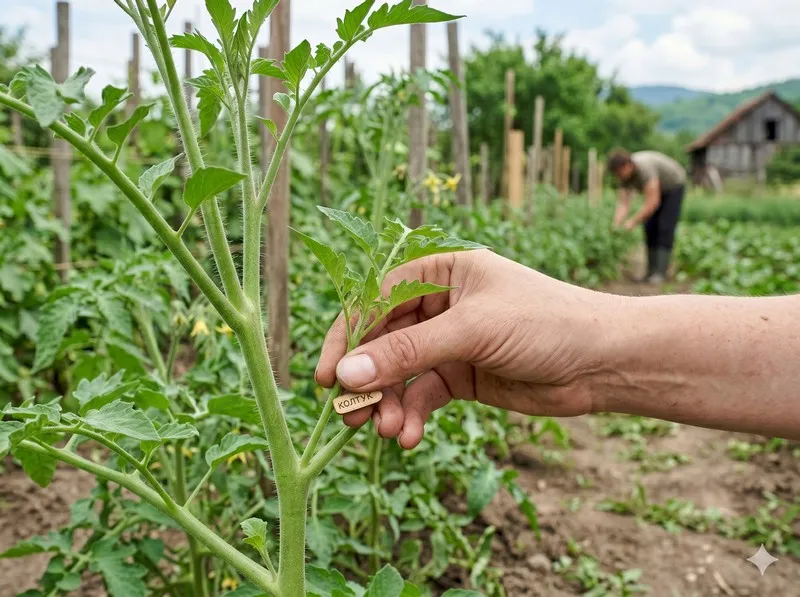
A tomato sucker is the side shoot that develops in the angle between the main stem and a leaf. On indeterminate varieties, these shoots are often removed to keep plants more open and to control their growth.
Suckers are easiest to remove while they are still small. Small shoots can be gently pinched out by hand, while larger ones are better removed with a clean cutting tool.
Not all tomatoes are trained in the same way. Determinate varieties have a more limited growth habit, and excessive sucker removal can reduce their yield. Indeterminate tomatoes are more commonly trained to one or two main stems.
As the season progresses, lower leaves can also be removed gradually, especially when they are yellowing, touching the soil or restricting airflow around the base of the plant.
The goal is not to strip the plant of its leaves. Leaves are essential for photosynthesis and for supporting fruit development and ripening.
Tomatoes need leaves, but they do not need chaos. The goal is airflow, not a bare plant.
Watering, Mulching and Feeding Tomatoes
Irregular watering is one of the main causes of stress in tomato plants. Alternating prolonged dry periods with heavy watering can contribute to cracked fruit and problems with nutrient uptake.
It is better to water deeply and consistently than to wet only the surface of the soil a little every day. This encourages roots to grow deeper and helps plants become more resilient.
- Water directly at the base of the plant.
- Morning is generally the best time to water.
- Avoid keeping the foliage wet for long periods.
- Keep soil moisture as consistent as possible.
- Use drip irrigation when practical.
Mulch complements this system. Straw, suitable dry plant material or another organic mulch reduces evaporation, suppresses weeds and protects the soil from excessive heat.
Mulch also reduces soil splashing onto the lower leaves during rain or watering. Do not pile it directly against the stem - leave a small open area around the base.
Too much nitrogen can produce a large, dark green plant with impressive foliage, but not necessarily more fruit.
Before planting, good soil is the foundation. Once plants are established, they benefit from moderate, balanced feeding. During flowering and fruit development, consistent moisture and balanced nutrition become particularly important.
| Stage | What matters most |
|---|---|
| Before planting | Mature compost, well-rotted organic matter and good soil structure. |
| After establishment | Moderate feeding without excessive nitrogen. |
| During flowering | A balance between vegetative growth and flower production. |
| During fruiting | Consistent moisture and a balanced supply of essential nutrients. |
If your plants are healthy, green and producing well, there is no reason to fertilize them simply because a calendar says it is time. Watching the plants themselves is more useful than following the same feeding schedule every year.
Common Tomato Problems and Prevention
Tomatoes are rewarding plants, but they respond quickly to combinations of unsuitable weather, overcrowding, inconsistent watering and poor air circulation.
With tomato diseases, prevention is much more useful than reacting late. Once a problem has spread through much of the plant, your options become more limited.
- Do not plant tomatoes too close together.
- Water at soil level rather than over the foliage.
- Gradually remove lower leaves that touch the soil.
- Use mulch to reduce soil splash.
- Remove suckers regularly from indeterminate varieties when appropriate.
- Maintain good airflow between plants.
- Remove diseased plant material from the bed.
- Avoid growing tomatoes in exactly the same spot year after year when possible.
Cool nights, prolonged moisture and dense foliage are a combination worth watching carefully.
A Simple Tomato Care Calendar
| Period | Main tasks |
|---|---|
| Late winter - early spring | Sow tomato seeds indoors according to your local planting schedule. |
| Early to mid spring | Care for seedlings, pot them on if needed, harden them off and prepare the beds. |
| After the last frost | Plant outdoors once conditions and soil temperatures are suitable. |
| Early summer | Tie plants to supports, remove suckers where appropriate, mulch and establish consistent watering. |
| Mid to late summer | Harvest regularly and watch for disease, heat stress, cracking and moisture problems. |
| Early fall | Continue harvesting, remove diseased leaves and monitor cooling temperatures. |
| End of the season | Remove spent plants, dispose of diseased material and prepare the soil for the next crop. |
Common Mistakes When Growing Tomatoes
Almost every gardener has made at least some of these mistakes. Tomatoes are generous plants, but they are also very quick to show us when something in their care is not quite right.
- Planting too early into cold soil.
- Spacing plants too closely.
- Failing to provide support or adding stakes too late.
- Frequently wetting the foliage.
- Allowing plants to dry out severely and then soaking them heavily.
- Using too much nitrogen fertilizer.
- Leaving every sucker on indeterminate plants.
- Growing tomatoes in exactly the same place every year.
- Ignoring the first signs of a developing problem.
The good news is that tomatoes teach us something every season. One year the problem may be watering, another year spacing, and the next it may simply be the weather.
A garden is not a sterile formula. It is observation, adjustment and a little extra attention at exactly the right moment.
My Take on Growing Tomatoes in the Garden
Tomatoes are among the most rewarding, but also the most instructive, plants we can grow. They quickly show us whether we planted them too closely, watered inconsistently, overfertilized or waited too long to manage their growth.
Sometimes we think the secret is all in the variety. And variety certainly matters. But very often the biggest difference comes from the simplest things: sun, soil, spacing, support, airflow and consistency.
The best tomato is not necessarily the largest one. For me, it is the tomato picked fully ripe, still warm from the sun and smelling like a real garden.
And if I had to sum up tomato care in one sentence, it would be this: do not leave them completely to themselves, but do not fuss over them so much that good care becomes interference.
Tomatoes do not need perfection. They need warm soil, enough sun, air between the plants, consistent moisture and a little order.
If we observe them regularly and respond early, most problems can be managed long before they turn into full-scale garden drama.