
Table of Contents
There was a time when Thuja ‘Smaragd’ seemed to become the default choice for new gardens and evergreen hedges.
And it is easy to understand why. Young plants are narrow, tidy, bright green and create an instant sense of structure from the beginning.
But over time, I started noticing the other side: browning tips, bare patches, weakened plants and entire hedges that no longer looked the way they did during the first few years.
That does not mean Thuja occidentalis ‘Smaragd’ is a bad plant. It simply means it is not a universal solution for every site and every soil.
Thuja ‘Smaragd’ can make an excellent hedge, but only when the growing conditions are chosen as carefully as the plant itself.
What Is Thuja ‘Smaragd’?
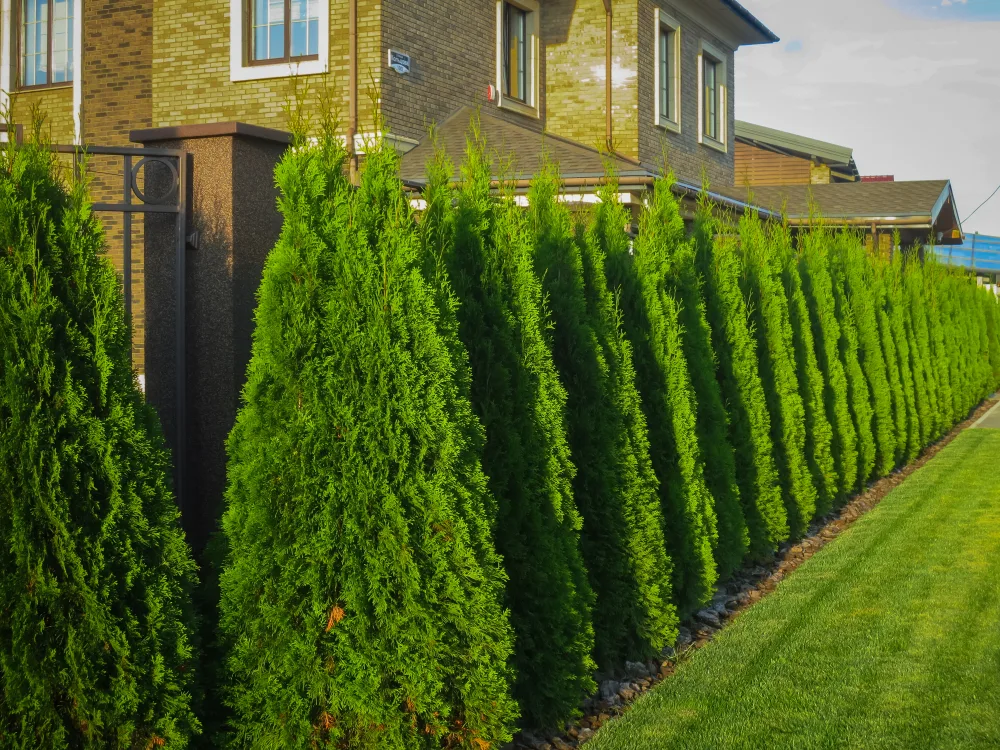
Thuja occidentalis ‘Smaragd’ is an evergreen cultivar of eastern arborvitae, known for its narrow, relatively uniform habit and bright green foliage.
Unlike many more vigorous evergreen screening plants, it naturally maintains a slimmer shape.
This makes it useful for formal hedges, narrower spaces and situations where we do not want an evergreen screen to become excessively wide.
Why Does Thuja ‘Smaragd’ Turn Brown?
A brown thuja is not a diagnosis.
The same visible symptom can be caused by several completely different problems.
Among the most common causes, I would look for a combination of:
- insufficient water;
- prolonged heat;
- poor drainage;
- transplant stress;
- strong winter winds;
- overly dense planting;
- pests or disease.
That is why I would not begin by applying a treatment “just in case.” I would first check what is actually happening around the roots and how the browning is distributed.
Insufficient Water Is One of the Most Common Problems
A young hedge in particular does not yet have a sufficiently developed root system to cope well with long dry periods.
This becomes even more important in hot, dry and windy conditions.
Frequent shallow wetting is not the same as proper irrigation. The aim is for water to reach the active root zone.
With a newly planted hedge, I would check how much water each plant is actually receiving and how deeply the moisture penetrates the soil. A system can run every day and still deliver too little water.
But Waterlogged Soil Can Be Just as Problematic
This is often overlooked.
If thuja is planted in heavy, compacted soil where water remains for long periods, the roots may suffer from poor oxygen availability.
Above ground, the result can once again resemble drought damage: weak growth, loss of colour and gradual browning.
So when a plant is struggling, I would check not only whether the soil is too dry, but also whether it is staying permanently too wet.
Spacing Between Plants Matters
The temptation is understandable: we want the hedge to look dense from the first year.
But if the plants are positioned too close together, their crowns eventually begin to crowd each other.
That can mean:
- less light inside the hedge;
- poorer air movement;
- more competition for water;
- more difficulty spotting problems early.
I would not determine spacing only by the size of the plants on the day they are purchased. The mature size matters much more.
A hedge does not need to be completely dense on the day it is planted. It needs enough space to become dense properly.
Some Interior Browning Is Natural
This is important too.
Evergreen does not mean that every piece of foliage remains green forever.
Older foliage in the interior can naturally lose colour and eventually shed, especially once it becomes shaded by newer outer growth.
If browning begins extensively at the tips, progresses rapidly or affects entire individual plants, however, I would look for another cause.
Spider Mites Can Be a Problem, but They Are Not the Cause of Every Brown Thuja
In hot and dry conditions, some mites can thrive on evergreen plants.
Symptoms may include fading, bronzing, yellowing or gradual thinning of the foliage.
But I would not diagnose mites from colour alone.
Water stress, root problems and some diseases can produce similar symptoms.
I check soil moisture, the root zone, the pattern of damage and the foliage itself before deciding whether pest treatment is actually necessary.
Winter Can Cause Brown Patches Too
Thuja ‘Smaragd’ is cold hardy, but that does not mean winter cannot leave visible damage.
Cold winds, winter sun and frozen soil can cause the foliage to lose water at a time when the roots are unable to replace it efficiently.
This can be particularly noticeable on exposed hedges.
So I would not assume that every brown patch in spring automatically means disease.
Soil Matters More Than It Seems
For me, this is one of the main questions before planting.
Thuja ‘Smaragd’ needs soil that retains enough moisture but also drains properly.
How I Would Plant Thuja ‘Smaragd’ Today
If I chose this cultivar, I would try to solve the main potential problems before planting.
I want to know whether it holds too much water or dries out very quickly.
Especially during the first few years, I would not rely on rainfall alone.
I plan according to mature size, not just the size of the nursery plants.
This helps keep soil moisture more even and reduces overheating.
A small change in colour is usually much easier to understand and correct than a nearly dead plant.
Does Thuja ‘Smaragd’ Look Dated?
For me, this is less about the plant itself and more about how it is used.
A very long, perfectly identical row can feel too rigid in a more natural garden.
But the same plant can work very well when it has a clear function and forms part of a richer composition.
For example as:
- a calm evergreen background;
- a relatively narrow privacy screen;
- a repeated vertical element;
- structure among looser planting.
I do not think a plant itself becomes outdated. More often, it is the way we use it that becomes repetitive.
When I Would Choose Thuja ‘Smaragd’
I would choose it when I want a relatively narrow, formal, evergreen screen and the site offers suitable growing conditions.
When I Would Choose Something Else
If the site is extremely hot, exposed to strong winds, difficult to irrigate or has problematic soil, I would consider other options as well.
But I would not automatically replace thuja with one particular species. The choice depends on what I actually want to achieve.
- cherry laurel - for a broadleaf evergreen background;
- photinia - when I want seasonal colour in the foliage;
- Leyland cypress - when I have more space and want stronger growth;
- mixed planting - when I want a more natural and varied boundary.
My Conclusion on Thuja ‘Smaragd’
I do not think this is a plant that should simply be dismissed.
But I would no longer choose it only because it is the most familiar option for an evergreen hedge.
I would start with the site: soil, water, wind, sun, available space and the kind of garden I want to have ten years from now.
Thuja ‘Smaragd’ can make a beautiful, tidy and long-lasting hedge when it is planted in the right place and receives sufficient water.
Browning does not automatically mean pests or disease. The cause is often a combination of root stress, water, climate and overly dense planting.
For me, the best choice is not the plant that looks perfect on the day it is planted, but the one that has a realistic chance of still looking good years later.