Tomatoes in the garden: planting, pinching and care
If there is one vegetable most strongly associated with the home garden, it is the tomato.
Not the cucumber, not the pepper, not the zucchini, no matter how important they are. The tomato is that garden symbol that makes people think of summer, salads, basil, cheese, and an aroma that supermarkets rarely manage to replicate, no matter how hard they try.
Tomatoes can be grown in a small garden, in raised beds, or even in large pots on a balcony. But for plants to be healthy, strong, and productive, we need to give them a few essential things: sun, good soil, stable support, proper watering, airflow between plants, and regular observation.
It sounds like a lot, but the logic is actually simple. The tomato is a strong plant, but it does not like chaos. If we plant it too densely, water it on the leaves in the evening, leave it without support, and expect it to handle everything on its own, at some point things usually go wrong — yellowing, blight, cracked fruits, weak yield, or a jungle of leaves with few tomatoes.
“Tomatoes love sun, air, and order. If we give them these in time, they reward us generously.”
If you are just starting with a vegetable garden, it is good to first understand the basics — location, soil, watering, beds, and seasonal maintenance. You can read the full guide here: Vegetable garden: where to start and how to maintain it during the season.
When to plant tomatoes in the garden
Tomatoes are heat-loving plants. They do not like cold soil, late frosts, or sudden temperature changes. That is why the most common mistake is planting them too early, just because the weather feels warm for a few days.
In most parts of Bulgaria, tomatoes are planted outdoors in May, when the risk of late frost has passed and the soil is sufficiently warm. In warmer regions this can happen earlier, and in colder regions slightly later.
- Early tomatoes: planted after temperatures rise, often under tunnels or temporary protection.
- Mid-season tomatoes: most often planted in May.
- Late tomatoes: can be planted later, but must have enough time to ripen before autumn cooling.
Do not rely only on the calendar. Check the soil, night temperatures, and forecast. A healthy seedling planted a week later in warm soil often performs better than one planted too early in cold ground.
Where to plant tomatoes
Tomatoes love sun. For good fruiting they need at least 6–8 hours of direct sunlight per day. In shady areas, plants may grow, but they will be taller, weaker, and produce fewer fruits.
The location should also be well ventilated. This does not mean strong wind exposure, but air movement between plants. Dense plantings, especially when leaves stay wet, are much more prone to fungal diseases.
Tomatoes like
- sunny locations;
- loose and fertile soil;
- regular but not excessive watering;
- good ventilation;
- stable support;
- mulched soil.
Tomatoes do not like
- constantly wet leaves;
- overcrowding;
- cold and waterlogged soil;
- sudden drought followed by heavy watering;
- too much nitrogen;
- planting in the same place every year.
If tomatoes, peppers, eggplants, or potatoes were grown in the same place last year, it is better to choose another bed. These plants belong to the same family and can accumulate similar diseases and soil problems.
What soil is best for tomatoes
Tomatoes prefer fertile, loose, and well-drained soil. It should retain enough moisture but not turn into mud after watering or rain.
Before planting, it is good to prepare the bed with compost or well-rotted manure. Fresh manure is not suitable directly for young plants, as it can burn the roots and cause excessive leaf growth instead of fruiting.
Good tomato soil must be alive. This means it contains organic matter, air, and structure. Tomato roots grow deeply when allowed, making plants more resistant to heat and temporary drought.
- Add compost before planting.
- Do not plant in heavy, compacted, cold soil.
- Improve clay soil with organic matter.
- In sandy soil, work on moisture retention.
- Do not overuse nitrogen fertilizers.
“For tomatoes, a good harvest starts even before the seedling goes into the ground.”
Choosing seedlings
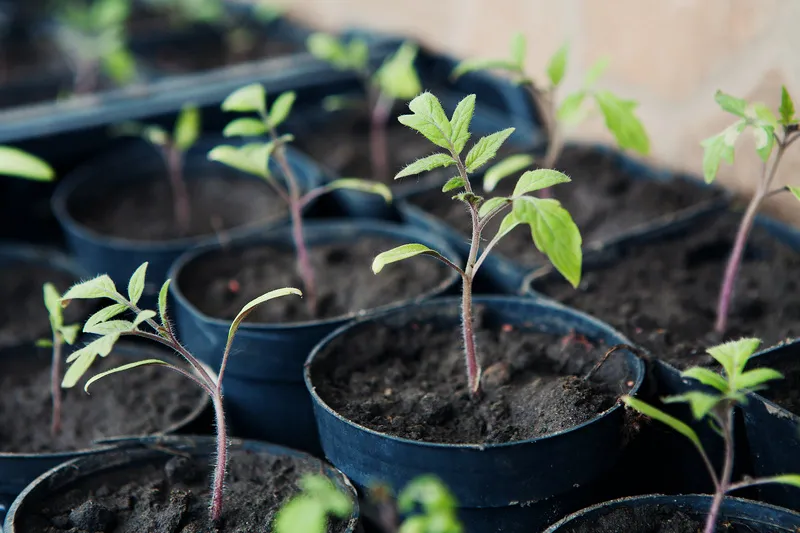
Healthy seedlings are half the success. Well-developed young plants establish faster, handle transplant shock better, and grow more evenly.
Seedlings should be compact, with a strong stem, fresh green leaves, and a well-developed root system. They do not need to be the tallest. In fact, overly tall and stretched seedlings are often weaker.
- Choose plants with a strong, not overly thin stem.
- Leaves should be green, without spots or yellowing.
- Avoid seedlings with signs of disease or pests.
- Do not buy already stressed plants.
- Harden seedlings before planting outdoors.
Hardening is important. If seedlings have been kept in a greenhouse or indoors, do not expose them directly to full sun and wind all day. Give them a few days of gradual adaptation.
How to plant tomatoes
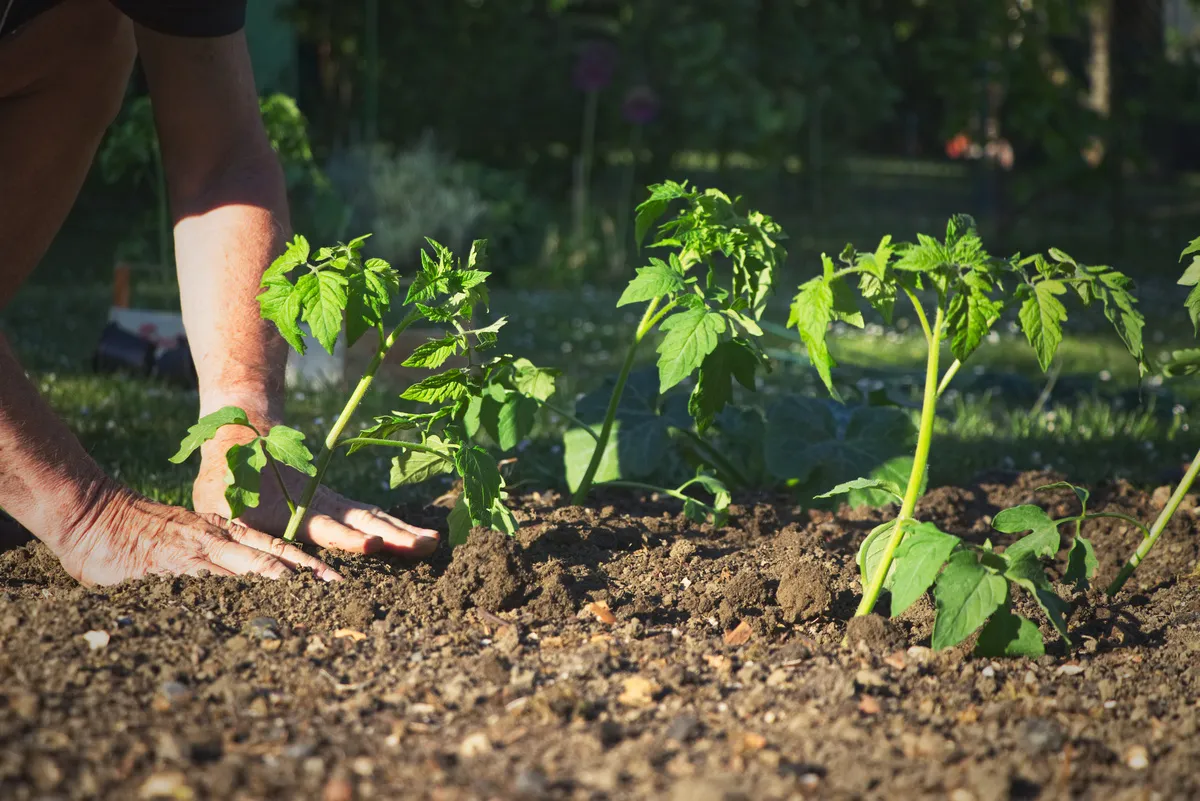
Tomatoes have a great advantage — they can form additional roots along the stem. That is why they can be planted slightly deeper than they were in the pot.
If the seedling is slightly stretched, it can be planted deeper or even slightly sideways, covering part of the stem with soil. This helps the plant develop a stronger root system.
| Parameter | Recommendation |
|---|---|
| Plant spacing | About 40–60 cm depending on variety and growing method. |
| Row spacing | About 70–90 cm for airflow and maintenance access. |
| Planting depth | Slightly deeper than the pot, especially for stretched seedlings. |
| Support | Install at planting time or immediately after. |
| First watering | Water generously at the base to settle soil around roots. |
Do not plant tomatoes too densely. At first the plants seem far apart, but after a month you will understand why space matters. Density is one of the main causes of poor ventilation, more disease, and difficult maintenance.
Supports and tying
Tomatoes need support, especially indeterminate varieties that grow tall and continue developing throughout the season. Without support, plants fall to the ground, fruits get dirty, leaves retain moisture, and disease risk increases.
Supports can be stakes, string systems, nets, metal spirals, or other stable structures. The important thing is that they can hold the plant when it starts bearing fruit.
- Install supports at planting time to avoid root damage later.
- Tie stems loosely without constricting them.
- Check ties during the season as stems thicken.
- Use soft ties, twine, or clips.
- Do not leave heavy fruit clusters unsupported.
Pinching tomatoes: why, when and how
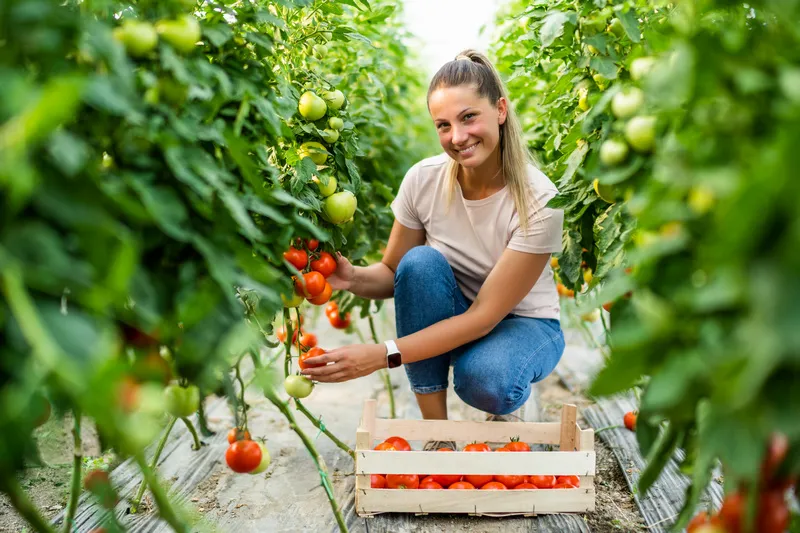
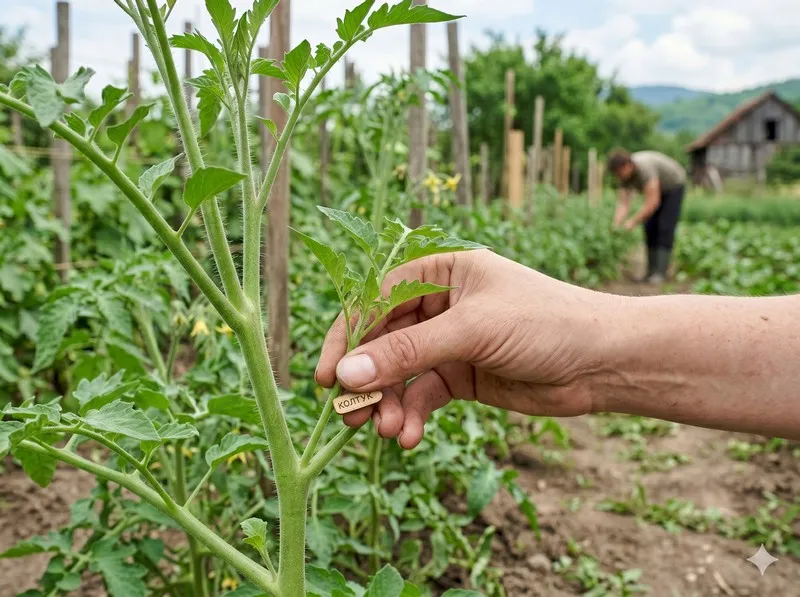
Pinching (removing suckers) is one of those gardening topics that sounds more complicated than it is. A sucker is a side shoot that appears in the angle between the main stem and a leaf.
In tall-growing tomatoes, these suckers are usually removed to direct the plant’s energy into the main stem, flowers, and fruits. If left unchecked, the plant can become a dense green mass that looks impressive but ventilates poorly and often produces uneven yields.
When to pinch
- when suckers are still small;
- in dry weather;
- best in the morning;
- regularly, at least once a week;
- before plants become too dense.
How to pinch
- small suckers are removed with fingers;
- larger ones are cut with clean tools;
- do not tear large parts roughly;
- do not pinch when plants are wet;
- do not remove too much foliage at once.
Not all tomatoes are pinched the same way. Determinate varieties often require less training because their growth is limited. Over-pruning them can reduce yield. Indeterminate varieties are usually grown on one or two stems.
Removing lower leaves
As the season progresses, the lower leaves of tomatoes often turn yellow, touch the soil, or block airflow. It is good practice to remove them gradually, especially those close to the ground.
This reduces the risk of mud splashing onto leaves during rain or watering and improves airflow around the base of the plant.
- Remove first yellowed and diseased leaves.
- Do not strip the plant suddenly.
- Work in dry weather.
- Use clean scissors for thicker stems.
- Do not leave diseased leaves in the bed.
“Tomatoes need leaves, but not chaos. The goal is not to strip them, but to give them air.”
Watering tomatoes
Watering is one of the most important aspects of tomato care. Irregular watering often leads to fruit cracking, stress, blossom end rot, and lower yields.
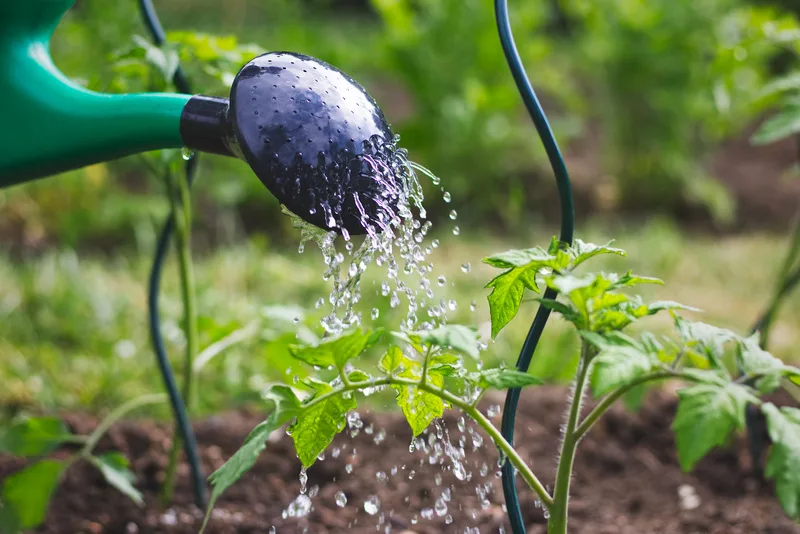
Tomatoes prefer deep and consistent watering. It is better to water less often but thoroughly than to water a little every day on the surface. Surface-only watering keeps roots shallow and plants more sensitive to heat.
- Water in the morning or evening.
- Avoid wetting the leaves.
- Maintain even moisture.
- Do not let plants dry out completely and then flood them.
- Mulch to reduce evaporation.
- Use drip irrigation if possible.
Drip irrigation is very effective for tomatoes because it delivers water directly to the base without wetting the leaves. This is important both for water efficiency and disease prevention.
Mulching tomatoes
Mulching is a small effort with a big impact. A layer of straw, dried grass clippings, leaves, or other organic material around the plants helps retain moisture, reduce weeds, and protect the soil from overheating.
For tomatoes, mulch has another benefit — it reduces soil splashing onto lower leaves during rain or watering. This matters because many problems start in a wet, dirty, and poorly ventilated lower part of the plant.
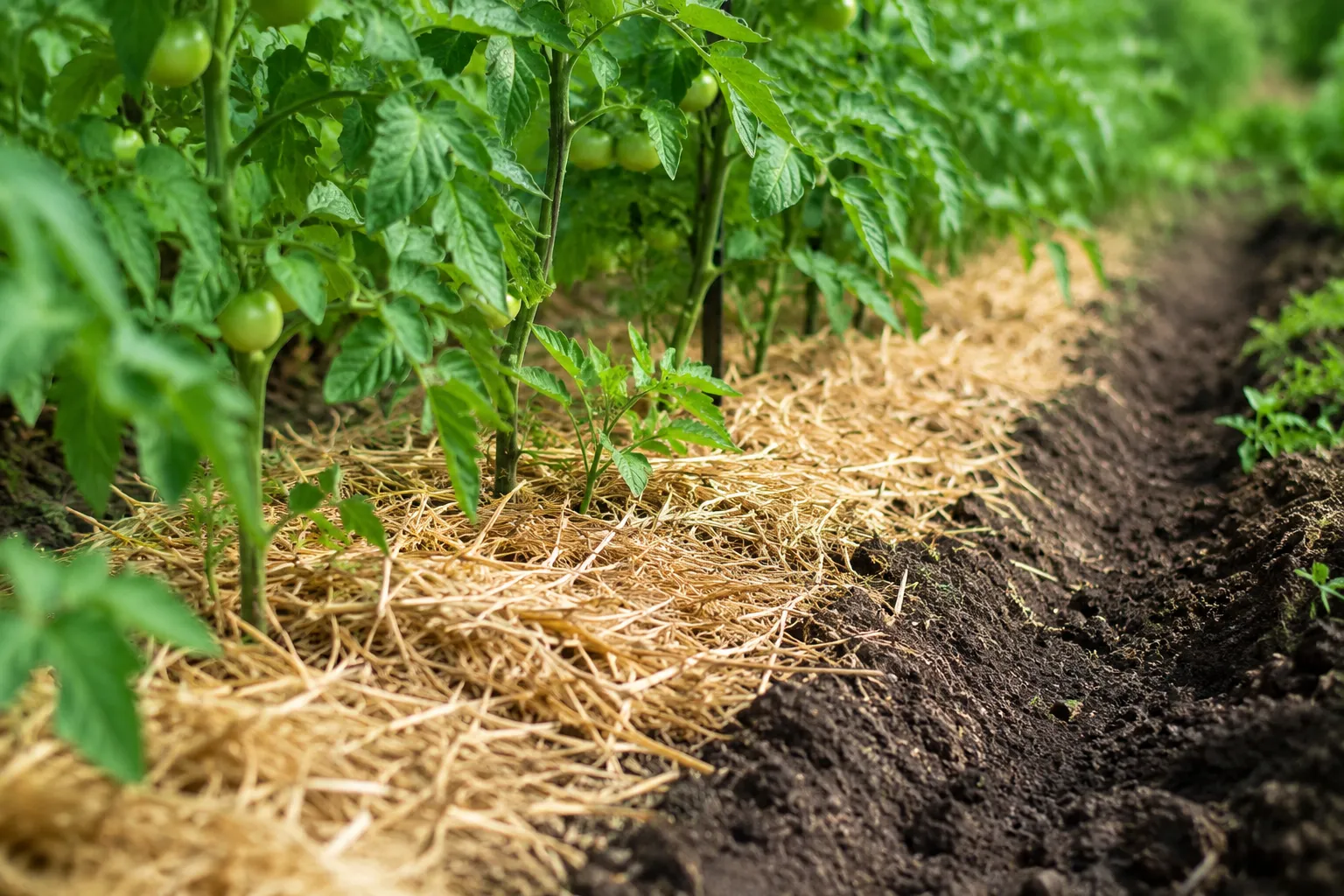
Do not pile mulch tightly against the stem. Leave a small free circle around the base to avoid excess moisture right where the stem enters the soil.
Feeding tomatoes
Tomatoes are hungry plants, but that does not mean they should be fertilized constantly and without balance. The most common mistake is excess nitrogen. In that case, plants become dark green and lush but produce fewer fruits than expected.
At the beginning, tomatoes need good rooting and moderate growth. Later, during flowering and fruiting, potassium, calcium, and balanced nutrition become more important.
| Stage | What matters |
|---|---|
| Before planting | Compost, well-rotted manure, soil improvement. |
| After establishment | Moderate feeding, avoid excess nitrogen. |
| During flowering | Balance between growth and flower formation. |
| During fruiting | More focus on potassium, calcium, and steady moisture. |
If plants look strong, green, and healthy, there is no need to fertilize out of fear. Observe instead. Leaves, flowers, and fruits tell much more than any fixed schedule that does not consider real soil conditions.
“Tomatoes do not want panic feeding. They need a system.”
Most common tomato problems
Tomatoes are generous plants, but not problem-free. Some issues come from weather, others from overcrowding, incorrect watering, poor ventilation, or excessive fertilization.
- Yellow leaves: may result from aging, overwatering, deficiency, or disease.
- Cracked fruits: often caused by irregular watering.
- Blossom end rot: linked to calcium uptake issues, often due to uneven moisture.
- Lots of leaves, few fruits: possible excess nitrogen or insufficient light.
- Flower drop: can occur due to heat stress, stress, or poor pollination.
- Blight: one of the most serious problems in humid weather and poor ventilation.
There will be a separate detailed article about tomato blight, as the topic deserves special attention — symptoms, prevention, first actions, and realistic measures without panic or random spraying.
Disease prevention
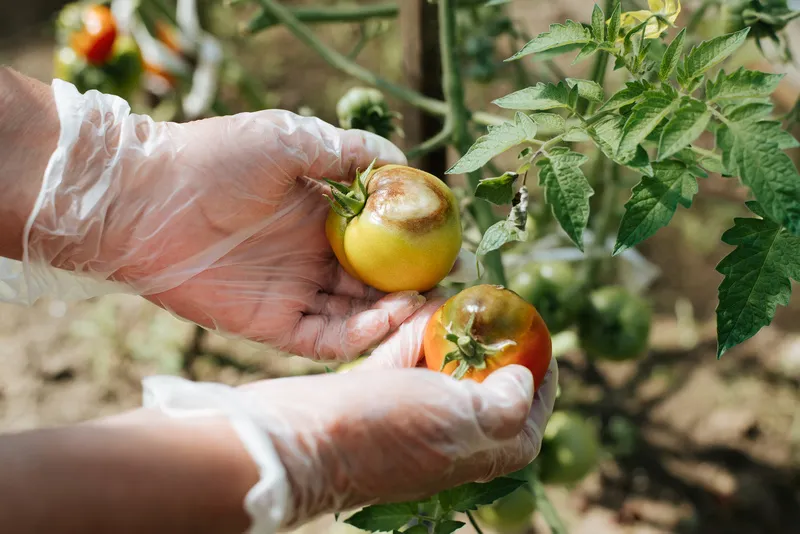
For tomatoes, prevention is much more important than late treatment. Once disease is strongly developed, options become limited. That is why it is better to create conditions where plants are less vulnerable.
Main preventive measures
- Do not plant tomatoes too densely.
- Water at the base, not on leaves.
- Remove lower leaves touching the soil.
- Mulch to reduce soil splash.
- Pinch regularly for tall varieties.
- Ensure airflow between plants.
- Do not leave diseased leaves in the bed.
- Rotate crops each year.
Wet weather, cold nights, and poor ventilation are a combination that requires attention. That is exactly when tomatoes need more care.
Mini care calendar for tomatoes
| Period | What we do |
|---|---|
| February – March | Sowing seedlings for early and mid-season tomatoes. |
| April | Seedling care, pricking out, hardening, bed preparation. |
| May | Outdoor planting after frost risk passes. |
| June | Tying, pinching, mulching, regular watering and first prevention. |
| July – August | Harvesting, feeding, monitoring for blight, pests, cracking, and heat stress. |
| September | Final care, removal of diseased leaves, harvesting ripe and semi-ripe fruits. |
| October | Cleanup, removal of plant residues, soil preparation. |
Common mistakes in growing tomatoes
Almost every gardener has made these mistakes. Tomatoes are generous but honest plants — they quickly show when something is wrong.
- Planting too early in cold soil.
- Overcrowding without airflow.
- No support or late staking.
- Watering on leaves, especially in the evening.
- Irregular watering — drought then flooding.
- Excess nitrogen fertilization.
- Leaving all suckers on indeterminate varieties.
- Planting tomatoes in the same place every year.
- Late response to early leaf spots.
The good news is that tomatoes teach us every year. One year it is watering, another it is spacing, another it is timing. Gardening is not a sterile formula — it is observation.
My opinion about tomatoes in the garden
Tomatoes are one of the most rewarding plants, but also one of the most educational. They quickly show whether we planted them too densely, watered them unevenly, over-fertilized them, or delayed pinching.
Sometimes people think the secret is in the variety. And variety does matter. But often the real difference comes from simple things — sun, soil, spacing, support, air, and consistency.
The best tomato is not necessarily the biggest one. The best tomato is the one we pick ripe, warm from the sun, with the aroma of a real garden.
If I had to summarize tomato care in one sentence, it would be this: do not neglect them, but do not overdo it either.
“Tomatoes do not want perfection. They want sun, air, water at the right time, and someone who looks at them in time.”
Related topics in Biogardn
- Vegetable garden: where to start and how to maintain it
- Tomato blight: symptoms, prevention and treatment
- Cucumbers in the garden: planting, watering and care
- Peppers in the garden: how to grow them healthy and productive
- When and how to plant garlic
- Raised beds for vegetables: benefits, sizes and maintenance
Sources and useful literature
- Institute of Vegetable Crops “Maritsa” – Plovdiv
- Agricultural University – Plovdiv
- Agri.bg
- Sinor.bg
- Educational and agronomic materials in vegetable production