Organic plant protection products can be very useful, but only when they are used against the right problem and at the right time.
Labels such as “organic,” “natural” or “plant-based” do not by themselves explain how a product works, what it controls or whether it is suitable for a particular crop.
The real questions are what the mode of action is, when the product makes sense to use and how it fits into an overall plant protection strategy.
An organic product does not replace diagnosis. It works well when we first understand exactly what problem we are trying to control.
What Do We Really Mean by an Organic Plant Protection Product?
In gardening practice, the general term “organic products” can include substances with very different origins and modes of action.
Some contain microorganisms, others mineral substances, oils, soaps or plant-derived active compounds.
Some products are registered for plant protection, while others are fertilizers, biostimulants or soil amendments.
This distinction is essential. A biostimulant does not become a fungicide simply because it improves the general condition of a plant.
Group Products by Function, Not by the Word “Natural”
It is more useful to think in terms of function rather than commercial names.
| Group | How it works | When it may be useful |
|---|---|---|
| Insecticidal soaps | Work mainly through direct contact against certain soft-bodied pests. | For early, exposed infestations when the product is labeled for the specific crop. |
| Horticultural oils | May act by direct contact against different pests, depending on the product. | When the label specifically lists the crop, pest and suitable conditions. |
| Azadirachtin or neem-based products | Some can affect feeding, development or reproduction of certain pests. | For specific labeled uses and sufficiently early application. |
| Microbial products | May contain bacteria, fungi or other biological agents. | Depending on the specific organism, crop and intended use. |
| Mineral products | Their action depends on the substance and may be contact-based or preventive. | Only when the product is labeled for the specific problem. |
Why Early Action Is Often So Important
Many lower-impact control products work best when a problem is detected early.
This is not because every organic product is necessarily “weaker.” More often, it is related to the way the product works.
A contact product must reach the pest. Once a colony becomes large, leaves curl or foliage becomes dense, reaching the target becomes much harder.
The same applies to diseases: protecting healthy new tissue is often a much more realistic goal than trying to restore tissue that has already died.
Application Technique Matters as Much as the Product
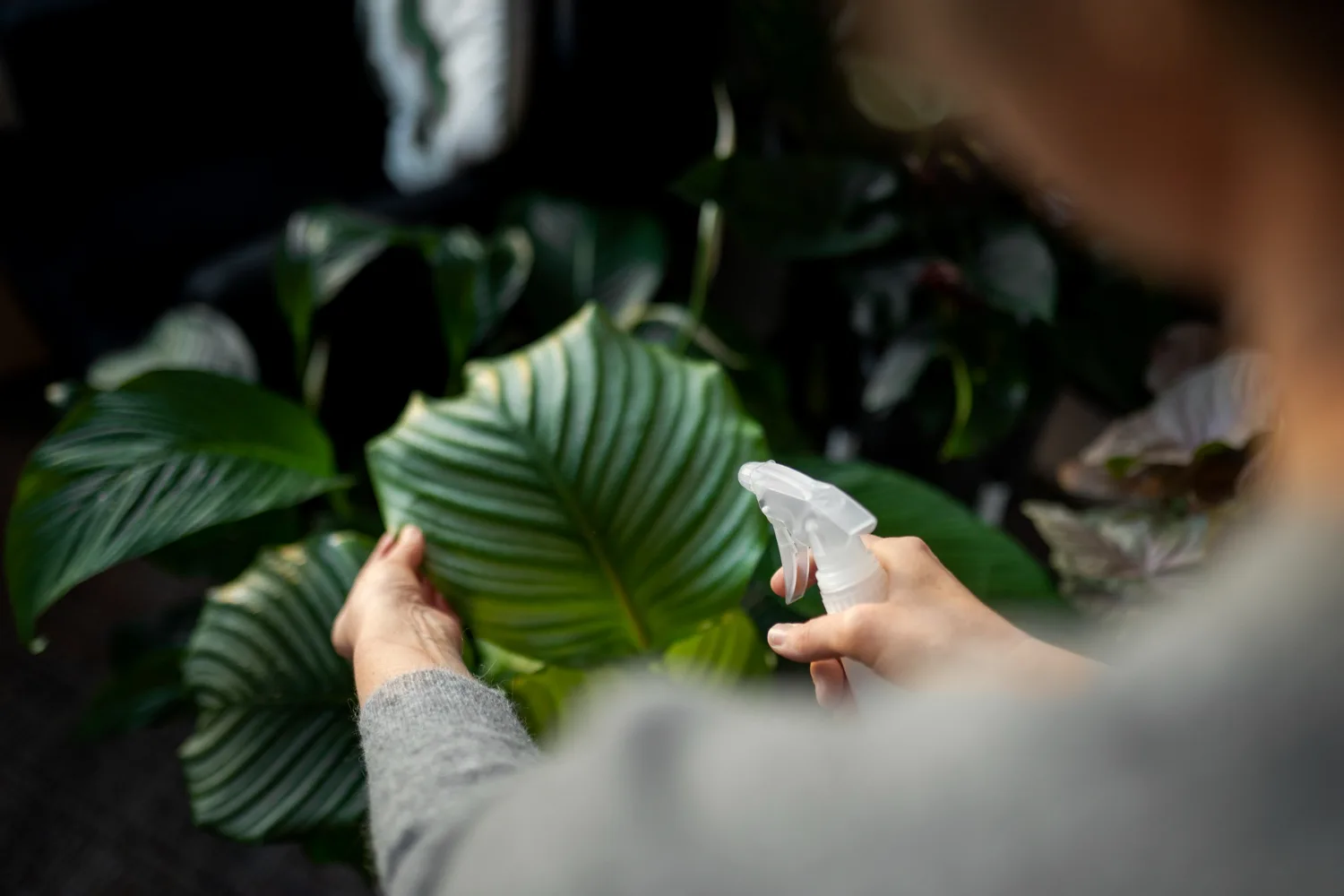
With many contact products, coverage is critical.
If aphids, whiteflies or spider mites are on the undersides of leaves, spraying only the upper surfaces may not provide adequate control.
But good coverage does not automatically mean spraying until runoff. Follow the application directions on the label.
Cooler parts of the day are often recommended, but specific temperature limits, rainfall, wind and pollinator restrictions should always be checked on the label of the actual product.
What May Work Against Garden Pests
For aphids and some other soft-bodied pests, labeled insecticidal soaps or horticultural oils may be useful.
They often require direct contact, which means the quality of spray coverage matters greatly.
With spider mites, the first step is to confirm that mites are actually the problem. They are not insects, and not every insecticide will control them.
Caterpillars, slugs and soil-dwelling pests require different approaches. Mechanical control, barriers, baits or specific biological products may be more appropriate than foliar spraying.
| Problem | Approach that may be useful | Important point |
|---|---|---|
| Aphids | Water, natural predators, labeled insecticidal soap or another targeted treatment. | Check the undersides of leaves and look for beneficial insects. |
| Spider mites | Reduce plant stress, wash foliage and use a product labeled specifically for mites. | Do not assume that every insecticide will control them. |
| Caterpillars | Hand-picking or a specific biological product, depending on the species. | Identify the pest before choosing a control method. |
| Slugs and snails | Hand-picking, physical measures and labeled baits when needed. | Foliar spraying is usually not the main approach. |
What May Work Against Plant Diseases
With plant diseases, the first task is correct diagnosis.
Powdery mildew, scab, bacterial leaf spots, viral symptoms and physiological damage are not controlled in the same way.
Some labeled biological, mineral or microbial products may provide preventive or limited post-infection activity, depending on the specific product label.
But no treatment restores dead or severely damaged tissue. The goal is usually to reduce new infections and protect healthy growth.
With plant diseases, the most realistic goal is often to protect what is still healthy, rather than expecting old damage to disappear.
Homemade Extracts Are Not the Same as Registered Products
Nettle, horsetail, garlic and other homemade mixtures are often discussed as part of organic plant protection.
However, they are not standardized. Their concentration and composition can vary considerably.
This makes their performance harder to predict, and the risk of phytotoxicity from an unsuitable concentration is not zero.
It may be part of personal gardening practice, but when dealing with a serious problem, a product with a clearly defined composition, intended use and application method is generally more predictable.
When an Organic Product Will Not Solve the Problem
No product can compensate for every problem in growing conditions.
If roots remain constantly waterlogged, if a plant is heavily shaded, if nutrition is unsuitable or the diagnosis is wrong, spraying will not correct the underlying cause.
An organic pesticide will not cure a viral infection. It will not restore rotted roots and it will not bring back dead leaf tissue.
How to Choose a Product More Carefully
Instead of asking “what is the best organic product?”, it is more useful to ask a few specific questions.
Common Mistakes With Organic Plant Protection Products
Organic plant protection products can be very effective when they are chosen for the specific problem, crop and mode of action.
The most important factors remain correct diagnosis, early detection, good application technique and following the product label.
Do not rely on the word “natural” as a guarantee of safety or effectiveness. What matters more is what the product contains, what it is labeled for and how it is used.
Good organic plant protection is not a refusal to control pests and diseases. It is a more precise, targeted and measured approach.